Gov. Kotek says her next Oregon budget will prioritize summer learning programs
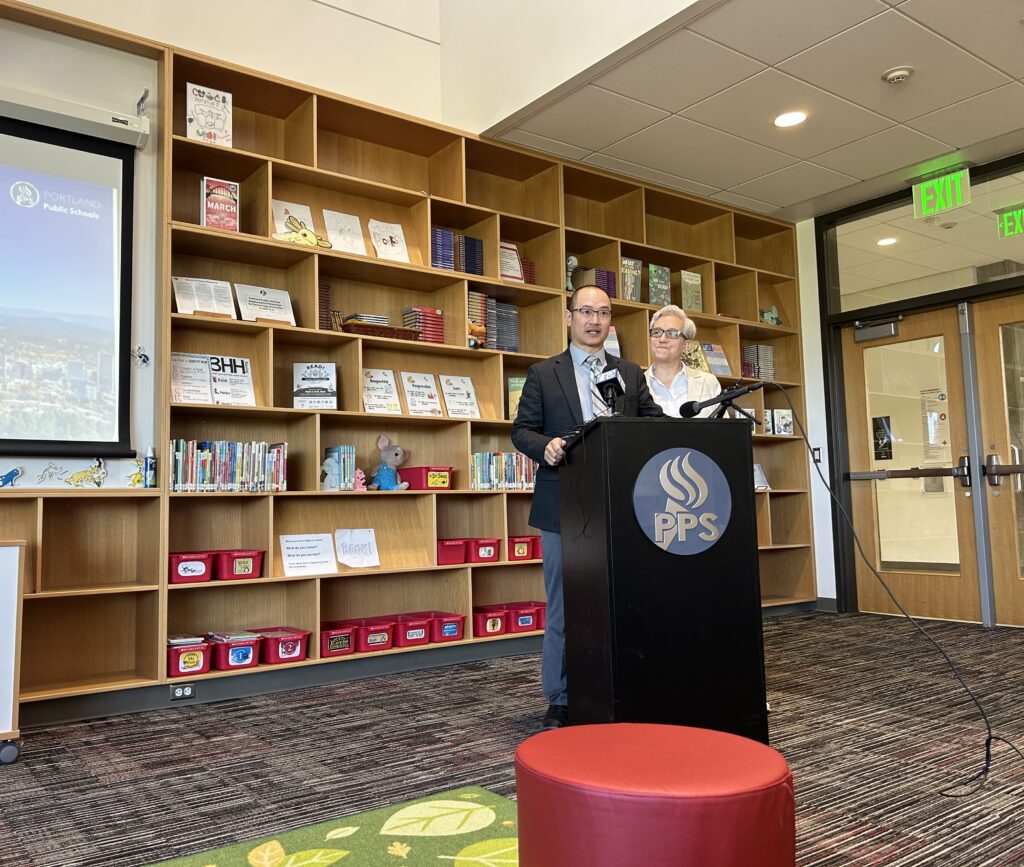
Oregon Gov. Tina Kotek joins Eddie Wang, chair of the board of Portland Public Schools, for a press conference on Tuesday, July 14th about summer learning in Portland. (Photo by Shaanth Nanguneri/Oregon Capital Chronicle)
PORTLAND — Gov. Tina Kotek said Tuesday she would prioritize education and summer learning programs in her forthcoming 2027-29 budget, warning that she has difficult work ahead of her to craft the financial plan that will inform next year’s legislative session.
“It will be a challenge to put my recommended budget together, but I would also say I worked on budgets in the Great Recession and through COVID,” she told reporters. “Oregon can figure this out. We need to prioritize what we need to fund, and my budget will be prioritizing education and particularly summer investments again because we know it works and we need to do that.”
The governor made her remarks at a press conference in Northeast Portland’s Faubion School, where she touted the performance of summer learning programs made permanent by the Oregon Legislature in 2025.
That included $35 million for summer learning grants for 2025, $35 million for 2026, and $12 million for June of 2027, which allowed Faubion School to host a five-week “acceleration academy” program during the summer. The program gives students from kindergarten to fifth grade breakfast and lunch, targeted literacy instruction, math lessons and hands-on projects such as robotics.
“The data has been very clear. Multiple decades of data have shown that summer slide is real,” said Eddie Wang, chair of the board of Portland Public Schools. “It affects our students that struggle the most, and that’s when they fall behind the most.”
The state’s broader push for early summer learning programs comes as Oregon continues to rank among the lowest states in the nation for performance on fourth-grade test scores for key subjects such as reading and math.
Kotek has also faced pushback from the state’s leading teacher’s union, as well as leaders of local school districts, for failing to adequately fund public education at a time when the state is staring down steep budget cuts due to tax cuts at the federal level. State Sen. Christine Drazan, a Canby Republican running to unseat her, has attacked the state’s poor educational performance in hopes of weakening the governor’s November reelection campaign.
On the local level, Portland Public Schools and its teacher’s union called upon state leaders in April to tap the state’s educational reserve funding to fill a more than $50 million dollar local budget gap. To reach into the state’s $1 billion Education Stability Fund, state law requires conditions such as negative economic forecasts and support from three-fifths of lawmakers in the Legislature. Kotek could also issue an emergency declaration, but she has yet to do so.
On Tuesday, however, she suggested that lawmakers would be far more open to tapping such funding in the 2027 legislative session. This year, lawmakers were able to recoup around $300 million in state revenue by disconnecting the state from certain tax cuts under the 2025 federal GOP tax and spending law that were replicated in state law.
But the cuts from the law and the costs it imposes on states for social services such as Medicaid and food stamps will continue to grow over the next few years.
“I think one of the things that legislators did do is they held back on tapping some of the reserves with the anticipation that this upcoming biennial budget would become more challenging than the one they just rebalanced here at the beginning of this year,” she said.
Since the launch of the summer program initiatives, some critics have also questioned the lack of uniform standards or requirements for outcomes given to districts receiving the money, as The Oregonian/OregonLive first reported.
Kotek on Tuesday also referred to an analysis from the Oregon Department of Education shared in February which showed the state’s summer learning programs provided support to nearly 30,000 students in 2025. She said student surveys indicate satisfaction with the program and that this summer could allow her to bring the Legislature more granular data on the per-student program cost.
“Stay tuned,” she said. “We have a lot to figure out before I get my budget up in December.”