Google Maps, Uber, and Wall Street Run on Socialism: How the U.S. Government Built the Global Positioning System
Today, I want to discuss the most successful government owned enterprise in, well, perhaps ever, but certainly in the last 50 years. It is so important and vital that multiple trillion dollar companies built their businesses on top of it, and everything from agriculture to social media to financial markets rely on it. It’s called the Global Positioning System, and it’s a network of satellites run by the government that can help anyone on earth figure out where they are or how to navigate to where they want to go. These satellites are, as one writer put it, “lighthouses in the sky.”
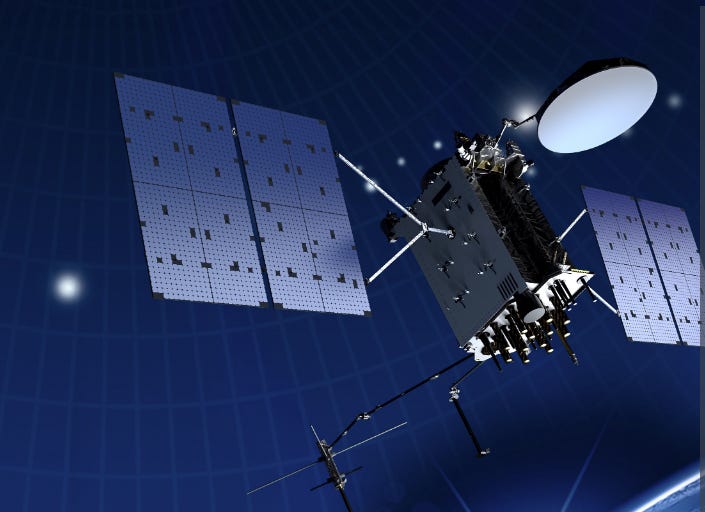
There are 6 billion GPS-enabled devices worldwide using this system, provided entirely for free by the U.S. government. Virtually every ship and airplane carries a bunch of GPS receivers to help with positioning, as do an increasing number of cars. Trillions of dollars of economic value flow from the GPS, which costs us just $2 billion a year to maintain, or $6 per American per year. It has certainly saved me endless amounts of time navigating, as Google Maps is basically just a skin and database running on top of GPS.
If Elon Musk ran the GPS system, you’d hear about it nonstop, valorizing this great man who built something so remarkable and valuable. But since it’s government invented, owned, and operated, it just works, quietly and without fanfare. And that’s a function of ideology, not so much what you hear about, but what you don’t.
I want to highlight this system because recently, a variety of political figures have started to argue for more public ownership and management of commercial systems. And GPS offers some good lessons about when and why different layers of government can run vital infrastructure, and when and why it may be a bad idea for public ownership. It also suggests how political rhetoric around government ownership is organized, and why anti-government critics avoid discussing the public systems that actually function.
Socialism! Or Is It?
Of late, the most notable shift in government ownership of commercial entities comes from the right. Since he took office last year, President Donald Trump has had the U.S. government buy a range of stakes in different companies, from rare earth magnet firm MP Materials to chip fabricator Global Foundries to Intel. There are a number of reasons for these purchases. One is financial – Trump brags about how much the government has profited from its stakes in these companies, especially Intel. But these acquisitions are also meant to ensure that the U.S. has some capacity to provide vital components for its own industrial sovereignty, particularly in high-tech fields.
It’s not just Trump, of course. Bernie Sanders has proposed having the state take ownership stakes in major generative AI firms, such as OpenAI, Anthropic, and xAI (now part of SpaceX). Sanders has a more social justice oriented approach, arguing that the public needs to both have some influence over the development of technology, as well as getting some financial benefits from these firms. Public ownership, and putting these stakes in a sovereign wealth fund, would ostensibly do both.
And then, this week, New York City mayor Zohran Mamdani announced he is following through on a campaign promise to set up five grocery stores that would offer a set of basic staples for 35% below standard pricing. The idea is to put these stores in neighborhoods without sufficient access to groceries and to have them run privately but with public subsidies.
While this enterprise is part of a wave of proposals to bring the state into more explicit ownership of commercial enterprises, the reaction to it has been far more pronounced than it was for the proposals of Trump or Sanders. In fact it was sort of feral. Conservative think tank denizens, Silicon Valley titans, and neoliberal commenters are horrified, making allegations that it is the start of a totalitarian Communist takeover. Here are a few representative tweets from venture capitalists or policymakers.
These claims are silly. Trump, Sanders, and Mandani are just being more explicit about political or policy actions building on what the U.S. government does all the time. The government runs the post office, vaccine development, and provisions medical care to hundreds of millions of people.
There’s more. Most doctors get trained by government funding, seven southern states gets electricity and fertilizer from the Tennessee Valley Authority, cities run public market spaces and electric utilities all over the country, and the military still manufactures some of its own weapons. Since Jimmy Carter, the U.S. government has had a strategic petroleum reserve, intervening in oil markets to manipulate pricing. And of course, the Federal Reserve is a price control agency, setting the price of all debt across the economy.
To speak of a banking system or economy without state enterprises, in fact, makes no sense.
Why No One Calls GPS Socialism
And that brings us to the Global Positioning System. The GPS system has a long and fascinating history, coming out of a collaboration between universities, the military, and electronics contractors.
This system helps with something fundamental to governance, which is navigation. Even before the founding of America, Boston Light, the first lighthouse on the east coast, was built by the Massachusetts colony in 1715, paid for by a tax on shipping. One of the first government agencies at the new Treasury Department was the Lighthouse Establishment, begun in 1791. The Navy’s Depot of Charts and Instruments dates to 1831; it is now the United States Naval Observatory, which has a role in the GPS system today.

The creation of the GPS system was situated in a Cold War industrial complex shaped by antitrust battles that took place during the New Deal. As Dan Schiller wrote in Crossed Wires, the Antitrust Division during and just after World War II forced patent licensing among high-tech firms, notably AT&T, to ensure that the military industrial complex could share knowledge across domains, paradoxically often in secret. When the space race started in the 1950s, the culture of openness led to the GPS system.
Here’s how.
In 1957, the Soviets surprised the world by launching the Sputnik satellite. Several Johns Hopkins scientists at the Applied Physics Laboratory studied the orbit of Sputnik, which was broadcasting a continuous tone. They realized it was possible to identify where Sputnik was by measuring the shift in that tone as it orbited, what is called the “Doppler effect.”
The Doppler effect is why an ambulance siren sounds different when it is coming towards you versus going away from you. If you measure that shift, you can identify location information. These scientists thought about reversing the dynamic of tracking Sputnik, instead using the orbiting probe to track the receiver itself. By triangulating across multiple satellites broadcasting a unique signal with a timestamp, these scientists realized, you could create a system to track the location of any object with a device.
The Navy, working with the APL, created the first GPS-style system, called Transit, in the 1960s, to help with the new the United States submarine ballistic-missile force. Transit worked, but could not precisely locate something, with an error range of between 25 meters and 0.2 nautical miles. It was still useful; Senator Hubert Humphrey had the Navy offer this system to commercial operators, and Magnavox started offering civilian user sets. But it needed improvement before becoming the GPS system we know today.
The Naval Research Laboratory (NRL) and Air Force Research Laboratory (AFRL), among others, worked on improving the technology. Super precise clocks were pivotal, because measuring a Doppler shift required measuring nanoseconds to ensure location accuracy. Quartz clocks, while seeming accurate to a normal person, drifted by milliseconds based on atmospheric or other pressures, which would be catastrophic for a location-based satellite system.
One innovation, created in 1949 by scientists at the National Bureau of Standards, was the “atomic clock,” which could tell time using the stable vibrations of atoms. Perfecting these clocks for usage in space required more work, and the first satellite with an atomic clock was launched in 1974. Today, the timing of these clocks is so good that high frequency trading on Wall Street is timestamped using the GPS system.
By the late 1970s, a new system to replace Transit was up and running. The Global Positioning System was integrated into air traffic control and the military, and it proved to be a critical technology in the 1991 Gulf War. It was slowly commercialized in the 1990s. GPS had two different modes, an encrypted signal that allowed for precision, and a general signal that anyone could use but which would not allow for exact location identification. In 2000, Bill Clinton ended this intentional degrading of the system, and opened it up to all commercial users at zero cost.
As a result, GPS became a free navigation and timing platform on which companies built entire businesses. Today, everything from Uber to Google Maps to precision agricultural equipment to electric utilities to emergency response to finance to communications networks rely on it, not just in the U.S., but globally. For a frame of reference, disrupting the GPS would cost just the agricultural sector a billion dollars a day. The amount of economic value it creates is impossible to measure, but reasonable guesses are in the trillions.
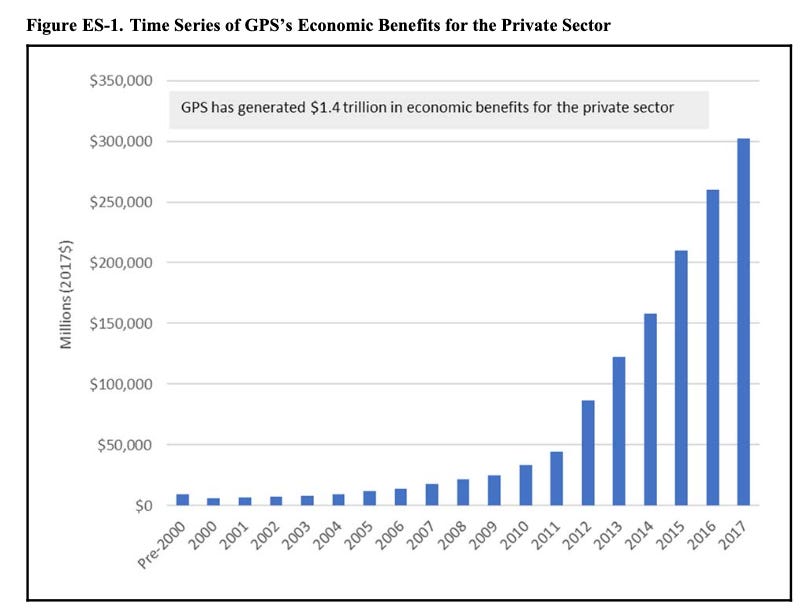
And yet, no one calls it socialism. Why not?
Well one reason is that, like the Post Office or the original internet, it’s content neutral. No one can get better GPS access than anyone else, your location is just where you are. Satellites send out the same “free, ubiquitous, reliable, accurate, and extremely precise” signal to everyone. It’s like the mail; while there are different classes of mail, the Post Office doesn’t move your mail faster based on what it says. The rules are clear, simple, and neutral.
Operationally, what this content neutrality means is that the government doesn’t have to make many political choices about who gets access or how the system works. The most meaningful choice was in 2000, when Clinton decided the military didn’t need special precision.
There are certainly still important national security questions around GPS, indeed Russia, the Europeans, and China have all launched competitive systems. But fundamentally, there is no domestic political debate over the management of GPS. It’s consensus that you should be able to tell where you are by getting access to the signal from this network of satellites, and we’re happy to pay a few dollars in taxes for it.
Another reason for the lack of criticism is that there’s a longstanding recognized role of government in navigation. For more than three hundred years in the colonies, and hundreds of years before that in England, the state played the role of managing lighthouses and helping ships get where they want to go. No one thinks of the sign for I-95 on a highway as socialism either.
But I think the real reasons no one calls it socialism are more cynical. First, the GPS just works, and people with large amounts of capital don’t want to concede that public systems can deliver value without their help. Second, people on the left don’t like to concede that American military capacity is useful and that the American state offers genuine public goods to the rest of the world.
Mamdani-Mart: Socialism Or GPS?
Let’s go back to the other proposals for state control of commercial enterprises, and the political reaction.
What Trump is doing, buying chunks of different firms that do important technological and industrial feats, is a bit like the development of the atomic clock. But it does have political questions around ownership and profit and corporate strategy that weren’t there with the GPS system. So it meets criticism. What Sanders is suggesting with generative AI firms is even more politically difficult, considering that would place the government in control of key instruments that create information used by hundreds of millions every day. Neither Trump nor Sanders provide any clarity on the rules the government should foster.
Ironically, the Mamdani grocery store notion, while not like GPS, is actually less arbitrary than what Trump or Sanders put forward. Mamdani published the plan for his grocery stories, and it has clear rules. The venture, as grocery expert and consultant to the project Errol Schweitzer noted, is modeled after commissaries on military bases. Unlike Trump or Sanders, there’s no attempt at creating wealth for the city, no sovereign wealth fund. It’s more like the GPS, a basic service.
The stories will offer a basket of essentials, notably fresh fruit, vegetables, meat, eggs, and milk, and will offer them for 35% less than comparable prices. Other foods will not have any sort of cost advantage. The stores themselves will be privately run as nonprofits, with high labor standards, and they will be in poorer areas. There’s nothing particularly easy to manipulate for political advantage, it’s just a straightforward city subsidy to ensure certain neighborhoods get access to fresh food. (Sure, you could argue that these stores distort certain markets, but then, the failure to enforce price discrimination laws for 40 years has already fostered food deserts.)
If Mamdani’s stores are reasonable and popular, then like the GPS system, the criticism will tamp down. And eventually, anti-government critics will start to pretend the stores had always been there, that there’s nothing unusual about a city providing this service. They will become like military commissaries, supermarkets operated by the Pentagon, which are ignored because they are useful and cheap. Quietly, there will be attempts to defund, to shut them down, to privatize them. But publicly, they will be ignored, and the next time a public official tries to do something, well, that’ll be SOCIALISM and the road to ruin.
All that said, these labels really are quite obnoxious, and intentionally so. There’s no such thing as ‘capitalism’ or ‘socialism,’ these “isms” the way we describe them, don’t make much sense. State ownership can work, it can also be a bad idea. The same is true with markets. The most left-wing socialist likes farmer’s markets, the most right-wing pundit disclaimed fraudulent derivatives markets in 2008.
But of course, none of these debates are actually about the role of the state, politics. It is about a much simpler question. Who gets to offer permission to use social resources? In the New Deal era, this question was generally answered in a more decentralized and democratic way, today it’s controlled by a narrow set of oligarchs. Going back four hundred years, we’ve had all sorts of terms to describe the same fight. It used to be the “divine right of kings,” then it was “bankers ethics,” and now it’s “the free market.” From the other side, the slurs were “leveler” or “the democracy” and now “Communist.”
It’s just politics, and inherent to any social order. So next time you flip open your phone to Google Maps,
Thanks for reading! Your tips make this newsletter what it is, so please send tips on weird monopolies, stories I’ve missed, or other thoughts. And if you liked this issue of BIG, you can sign up here for more issues, a newsletter on how to restore fair commerce, innovation, and democracy. Consider becoming a paying subscriber to support this work, or if you are a paying subscriber, giving a gift subscription to a friend, colleague, or family member. If you really liked it, read my book, Goliath: The 100-Year War Between Monopoly Power and Democracy.
cheers,
Matt Stoller