Local food-rescue nonprofit wins international prize for climate solutions
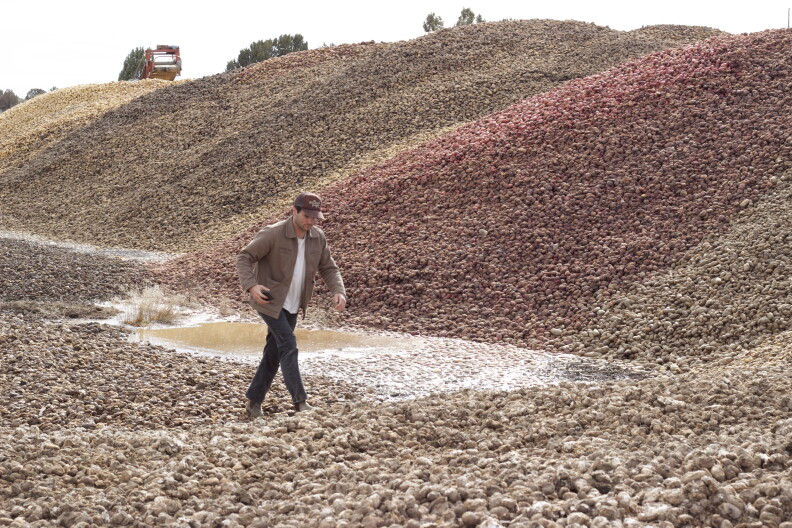
Aidan Reilly, who grew up in Santa Monica, was in college when the pandemic hit. Back at home, he decided to volunteer at his local food bank.
“And they said, ‘We don’t need volunteers. We need food, especially fresh food,’” Reilly told LAist.
That inspired him and a couple of friends to found the Farmlink Project. They cold-called hundreds of farmers across the state, learned about various produce markets and what causes farmers and warehouses to have to dump their food, and figured out how to build a truck fleet to pick up that food on a dime.
Today the nonprofit rescues millions of pounds a week from farms and warehouses in California and across the country.
“We’ve moved well over half a billion pounds of food at this point, and that’s at a rate of about 5 million pounds a week of usually almost entirely fresh produce,” Reilly said.
While Reilly is by no means the first to attempt food rescue to address food insecurity, the scale at which his company does it has earned international attention in large part because of their scale — they mostly work in California but do have operations in all 50 states.
The nonprofit was recently one of 10 companies around the world awarded the Keeling Curve prize. The award comes with a check of $50,000, which Reilly said will go, in part, to paying the salaries of their small team of 25, as well as trucks to move food from farm to food bank. He estimated they could move another 500,000 pounds of fresh produce with the funds.
That food goes to people facing hunger, instead of rotting in farm fields or landfills and releasing the powerful greenhouse gas methane into the atmosphere, further heating up our planet.
Reilly says the rescues also help farmers save money on costly dumping fees for food that may not be grocery-store perfect, but is fine to eat.
“We make sure it gets to people who need it and provide a tax benefit back to the farmers,” he said.
A long tradition
With his nonprofit, Reilly joins a long tradition of neighbors stepping up to help their neighbors in times of crisis. One of their primary partners, Food Forward, has a similar story, as does another hyperlocal partner, United Hands of Compton, which was also launched during the pandemic.
Arnali Ray, executive director of the Hollywood Food Coalition, which has operated since 1987, said the Farmlink Project is an important addition to the existing food rescue “ecosystem.”
“You need all the different players at the different scales in order to make this happen,” she said.
Federal cuts and state policy add to the need
Ray said cuts to and additional requirements to access federally funded benefits, such as CalFresh, as well as rising grocery prices and other costs of living, are rapidly increasing the number of people who are food insecure.
“We’ve started to see more people that are housed that are seeking resources,” Ray said. “We’re noticing more people opting out [of CalFresh], especially folks who are undocumented and scared and nervous about putting their information into the system.”
State policies, such as SB 1383, which requires residents and businesses to divert food from landfills, is pushing more demand for food rescue at the same time. The law was intended to prioritize food rescue, but has proved complicated for many businesses to implement because the mandate came with no long-term funding and requires tailored approaches for each business. And that can take time and resources that many lack.
Still, Ray said they’re getting more calls from local restaurants, grocery stores and other potential food donors who are trying to comply.
“ I look at this as a perfect opportunity because we’ve got such an abundance of food, and we have so many people who are starving,” she said.