Election officials reel over ‘logistical nightmare’ as Trump’s mail ballot order takes shape
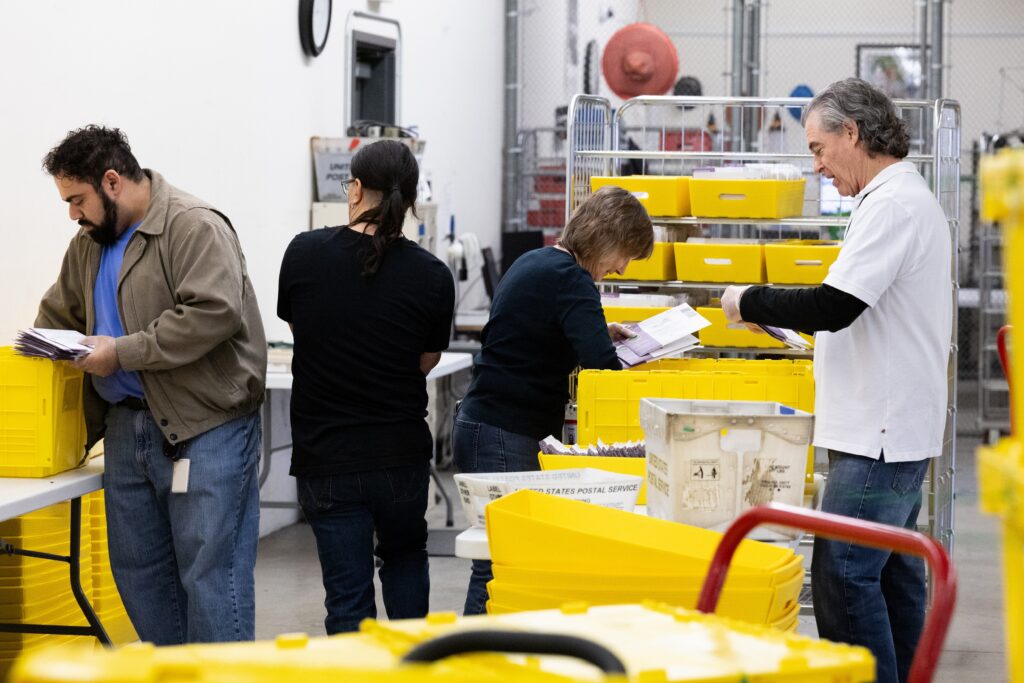
Election workers sort ballots at Contra Costa County’s election operations facility on May 27, 2026 in Martinez, California. (Photo by Benjamin Fanjoy/Getty Images)
As election officials across the country steel themselves for the midterm elections in less than five months, President Donald Trump’s executive order restricting voting by mail threatens to upend their preparations.
The executive order instructs the U.S. Postal Service to refuse to deliver ballots in states that don’t provide lists of voters or meet other requirements. It has created a sense of deep uncertainty and concern among election officials as they consider how to comply, according to a review of court documents and interviews with election officials and experts on election administration.
The March 31 executive order, and a proposed Postal Service rule published June 2 that would put the order’s requirements into effect, raise serious logistical and procedural challenges for those running elections, they say. Rural areas with limited resources are especially at risk, but jurisdictions of all sizes could be forced to scramble.
The executive order is the latest step taken by Trump to assert control over state-run elections, along with the stalled SAVE America Act, which would require voters to provide documents proving their citizenship. The Justice Department, under Trump’s control, is also trying to obtain state voter rolls.
“This is just another death by a thousand cuts that clerks have been experiencing since the 2020 elections,” said Barb Byrum, the Democratic clerk of Ingham County, Michigan, which includes Lansing.
First-ever national voter list
The order and the rule require states to provide lists of mail-in voters if they want the Postal Service to deliver ballots, marking the first time the federal government has created a national voter list.
Mail ballot envelopes must meet certain design standards. And federal agencies have to compile lists of voting-age citizens to share with each state in an effort to root out noncitizen voters.
But Democratic states and voting rights groups argue the executive order — and the accompanying proposed rule — represent an illegal overreach by Trump because states administer elections under the U.S. Constitution. Trump and his Republican allies say the restrictions are necessary for election security and to combat noncitizen voting, which occurs extremely rarely.
The Postal Service didn’t respond to questions from States Newsroom. The agency has said the rule “will facilitate the faithful execution of federal law.”
Multiple lawsuits have been brought against the order, but a federal judge in Washington, D.C., in May declined to halt it, partly because the Trump administration hadn’t taken enough action to implement its requirements. Another federal judge in Massachusetts is weighing a separate request to block the order.
With the executive order still in effect, at least for now, election officials and experts who work with them are taking the ramifications of it and the proposed Postal Service rule seriously.
“We don’t have a national voter registration list. We don’t have, currently, a list of sanctioned, authorized voters to vote by mail at the federal level,” said Tammy Patrick, chief programs officer at Election Center, operated by the National Association of Election Officials. “That’s a big, big change in the way elections have always been conducted.”
Sweeping changes very quickly
In court papers filed in May, local election officials and local governments representing 26 jurisdictions across the country warned the executive order would “severely disrupt” local election administration and force the implementation of sweeping changes within months. Implementation of the order’s requirements will largely fall on local election officials, they argued.
Byrum was among the officials to sign onto the brief, along with others in Boston, and counties in Pennsylvania, Washington, Wisconsin and elsewhere.
Under the executive order, states that want to send ballots through the mail must provide the Postal Service with lists of voters they intend to provide a mail ballot. Local election officials will play a large role in helping states develop these lists, according to the court papers, and will have primary responsibility to help voters address any errors.
And Trump wants it all in place before November. The executive order’s proposed timelines “present a logistical nightmare for local election officials,” the officials warn.
“The general rule is don’t make changes before a big election because there’s always something you didn’t think about,” said Carolina Lopez, executive director of the Partnership for Large Election Jurisdictions, a nonpartisan organization for election officials in jurisdictions of at least 250,000 people.
The proposed Postal Service rule says the agency would launch a portal where states would submit voter lists and make updates. But a number of questions remain, said Lopez, who previously spent a decade administering elections in Miami-Dade County, Florida.
The portal poses the potential for bottlenecks in the election system and it’s unclear what would happen if it was ever offline. The United States has a decentralized election system, with states each running their own elections. By contrast, the Postal Service portal would create a single point of failure, raising concerns about the security of information on tens of millions of voters.
Additionally, while every state maintains a voter registration list, there is no nationwide standard for the formatting of that data. It’s unclear whether the portal will accept data in a variety of formats — the proposed rule only says the Postal Service wouldn’t alter the data provided by states.
“It looks a little different across the country and therefore normalizing the data will be a process,” Lopez said.
Struggle for small, rural counties
The Department of Justice initially said in a court document that the Department of Homeland Security planned to obtain voter data from the Postal Service before backpedaling a few days later. Still, Homeland Security continues to have “preliminary conversations” about data sharing, the Justice Department said in a subsequent court filing.
DHS operates the Systematic Alien Verification for Entitlements, or SAVE, system that can scan voter data to identify possible noncitizens. The Justice Department has sued 30 states in an effort to force them to turn over their unredacted voter rolls, which include sensitive personal data such as dates of birth, driver’s license and full or partial Social Security numbers, for the purpose of running the information through SAVE.
The proposed Postal Service rule also imposes standards on ballot envelopes that states must meet if they want to send ballots through the mail.
Envelopes must include an election mail logo, be automation compatible and have a bar code that allows for tracking. These are already considered best practices — and many jurisdictions across the country already follow them — but the rule would make them mandatory.
Election offices in small, rural counties may struggle to comply. In many places, a single person is in charge of elections and may not even be on the job full time, Patrick said.
“There’s rural offices all across the country, some of them don’t have their own computer in their office — they are sharing it with the tax assessor or whatever — they don’t have the ability to generate those serialized tracking codes, intelligent mail bar codes,” Patrick said. “Because they’re physically hand-writing these envelopes out or they’re using a rubber stamp with their address on it.”
Neither the executive order or the proposed Postal Service rule include any federal funding for implementation, something that would likely have to be appropriated by Congress.
Some Republican states have championed the executive order. A dozen GOP state attorneys general filed court documents defending the order and arguing that it “will enhance the security of absentee voting.”
“It is vital to the strength of our republic that we ensure only American citizens vote in our elections and that mail-in and absentee ballots are secure and reliable,” South Carolina Attorney General Alan Wilson said in a statement earlier this spring.
But Matt Crane, a Republican who is the executive director of the Colorado County Clerks Association, said the executive order and the proposed rule mark an overreach by the federal government into duties best left to states and local governments.
The biggest reaction among Colorado clerks, he said, has been, “why?”
“No offense to our friends at the post office,” Crane said, “but I trust our processes more than I trust theirs.”