Dozens of women and children in LA who survived domestic violence at risk of losing shelter services
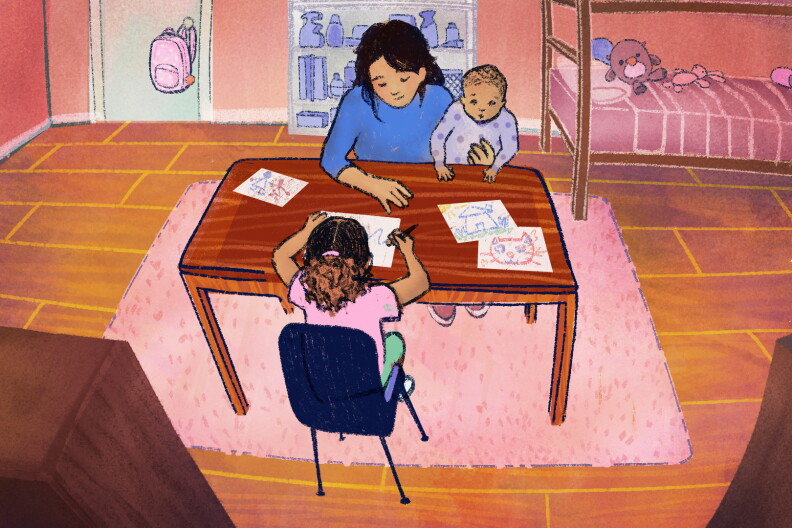
More than three dozen women and children are at risk of losing the services that supported their families after escaping domestic violence, officials are warning.
The contract for an L.A.-area transitional shelter for domestic violence survivors expired at the end of March. No funding has come in since then through the region’s troubled homeless services agency, according to Jewish Family Service L.A., which runs the shelter.
That has forced the organization to cover the roughly $300,000 portion of annual costs through the Los Angeles Homeless Services Authority, also known as LAHSA, to keep the shelter up and running, according to Eli Veitzer. If that contract doesn’t come through, he said the shelter won’t be able to take in new survivors and officials would have to find other arrangements for the families currently in their care.
“The women who are in our shelters have experienced enormous trauma and fear and violence,” he told LAist. “But the children who are in our shelters are just children, and they’ve also experienced all of that.”
“I’d like to know how they would explain to a 10-year-old girl who’s gone through hell why there’s no more money for the shelter?” Veitzer added, his voice cracking with emotion.
The number of people experiencing homelessness in L.A. from fleeing domestic or intimate partner violence jumped more than 43% since early last year, according to the results of the annual point in time count released in recent weeks. That equates to more than 5,690 people in the city.
The shelter contract is through LAHSA, and funded by the U.S. Department of Housing and Urban Development. LAHSA told LAist the plight of providers like the shelter is why LAHSA is suing HUD over its decision to suspend the agency from federal grant activity.
“Their actions are putting thousands of people who are safely inside housing in danger of returning to the street,” Ahmad Chapman, a spokesperson for LAHSA, said in an email.
A survivor’s ‘safe haven’
Yaminah is a single mother of two children, a 6-year-old daughter and an 11-year-old son, and a former resident of the Hope Transitional Shelter that’s dealing with the budget shortfall.
She suffered more than eight years of emotional and physical abuse from her children’s father, whom she said she now has a restraining order against. LAist is not publishing her last name out of concern for Yaminah and her children’s safety.
In 2024, Yaminah and her children ended up homeless after fleeing the violence. She said she called more than 20 shelters looking for help and a place to stay. But every call was a closed door, with wait lists stretching up to two years, she said.
Their first stay at an emergency crisis shelter connected her to the Hope Transitional Shelter, which provides free, long-term services for women and children who are survivors of domestic violence. Families get assistance with case management, as well as parenting and mental health support. The average stay is between 9 to 15 months, and the eventual goal is to help families move into their own housing.
Yaminah described the transitional shelter as a “safe haven” that gave her family a chance to get back on their feet.
“We didn’t have to worry about our fear that ‘Oh what if he finds us,’” she added. “It just gave us that sense of I’m safe, someone else cares, someone is here to help me. And that’s so important, because when you’re in a domestic violence situation, you feel alone.”
Yaminah and Veitzer, who leads the shelter organization Jewish Family Service L.A., said many survivors stay in domestic violence situations because they don’t know a way out. Yaminah said a loss of funding could be “detrimental” with fewer shelter beds and even longer wait lists.
“What options are you giving them? Where do they go? So do I just stay with the person that’s abusing me?” she said. “If the shelters are not fund[ed], it’s out of their hands. How can they help us?”
How we got here
HUD suspended LAHSA from federal grant activity in June, pending an investigation into alleged mismanagement by the agency. HUD has said the suspension means LAHSA cannot fulfill its role as collaborative applicant for the entire region’s application for federal homelessness dollars for the upcoming fiscal year.
LAHSA filed a lawsuit challenging the suspension a few weeks later, and a federal judge intervened last month. U.S. District Judge David O. Carter issued a legal order pausing HUD’s effort to suspend LAHSA pending an Aug. 6 court date.
Chapman said the agency is looking forward to this week’s hearing “where LAHSA will have its day in court on behalf of all of these federally funded service providers.”
The shelter is being left in limbo amid the federal funding drama, according to Veitzer. LAHSA’s contract is its largest funding source, accounting for 50% to 60% of the program’s budget.
Veitzer said LAHSA and the L.A. County Department of Homeless Services and Housing have been “fairly good” about communicating the status of the legal fight, “but most of what they’re communicating is we don’t have any answers for you right now.”
He said the most immediate concern is getting a signed contract and funding for ongoing services.
As the organization waits, Veitzer said he’s focused on the 12 women and 25 children living in the shelter, not how the politics play out.
“I do get emotional about this because people are very busy doing a lot of legal stuff, and we’re just looking at the hopes and dreams of women and their children to actually live a better life,” he said.
Aaron Schrank’s reporting contributed to this story.