Dodos probably weren’t as stupid as historians made them out to be: new research

The dodo has been extinct for more than 300 years, wiped out within decades of humans arriving on its home island of Mauritius, but it lives on in the public imagination.
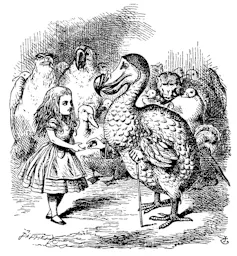
John Tenniel

This famous flightless bird has become a symbol of extinction. Its demise is often portrayed as almost inevitable: a supposedly foolish creature that naïvely approached the sailors who killed it.
Early accounts even describe people holding a captured dodo and letting it cry out so others would wander over. In the 18th century, Swedish naturalist Carl Linnaeus dubbed the species Dodus ineptus after its reputation for dim wits and silliness.
But new research shows this image is misleading. The dodo was likely no less intelligent than any modern bird. It may also have possessed a rare and overlooked ecological trait: an adaptation to life in low light.
A closer look inside a vanished bird’s head
With a team of collaborators across Canada, Australia, the United States, Europe and the UK, our new study looked in detail at the reconstruction of the dodo’s brain.
There are only three completely preserved dodo skulls in existence. Using high-resolution CT scans of all three, we could reconstruct the shape of the dodo skull and get a detailed idea of the size and shape of its brain.
This also allowed us to digitally measure the structures associated with vision, smell and cognition (or “smarts”). These scans can also be shared further with the research community.

Sara Citron, CC BY
The dodo was a member of the pigeon family, so its living relatives include the pigeons in our cities and the doves whose calls accompany mornings around the world. Pigeons are famous for their navigational skills and are widely used by scientists to study animal cognition.
Is there any indication that the dodo’s brain was much different? When we compared the dodo’s brain to that of pigeons, we found that the dodo’s forebrain, linked to cognition and memory, was similar in proportion to other pigeons, when compared to the rest of the brain.
In other words, there is no evidence the dodo was less intelligent than any other pigeon. This is also backed up by previous research suggesting that the overall brain size was similar relative to body mass compared to other pigeons.
So we think the dodo’s trusting behaviour was because it simply had nothing to fear until humans arrived, as is common for island species with no predators.
A giant pigeon with an unexpected twist
Where the dodo does differ dramatically from other pigeons is in its sensory systems, particularly its vision. The dodo’s optic lobes, the brain region that first processes visual information in the bird brain, are unusually small – not just compared to pigeons, but also compared to another extinct flightless relative, the Rodrigues solitaire.
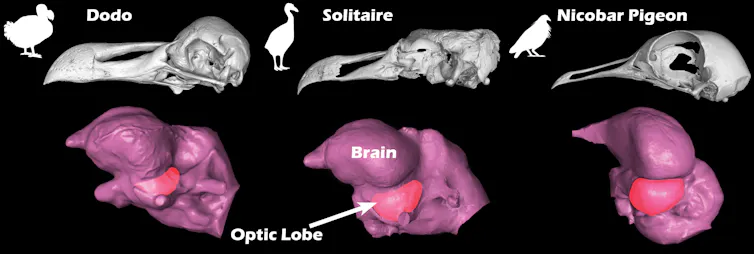
Sara Citron, CC BY-NC-ND
Smaller optic lobes are typically found in birds adapted for a nocturnal lifestyle, such as owls, kiwi, and the Australian night parrot.
They are likely a product of specialising for low light vision, where the light received by the retina is “summarised” by fewer nerves. This increases the contrast of the image, making it easier to see in the dark.
Although we have no way to examine the retina of the dodo, the implication of small optic lobes is that it may not have been a strictly daytime bird. Instead, it may have been active at dawn or dusk or even at night, a behaviour otherwise unknown among modern pigeons and doves.
Why would a dodo be active in the dark?
If the dodo spent more time foraging in low light, what might have driven this behaviour?
One possibility is competition. Mauritius was once home to large populations of giant tortoises, which would have fed on many of the same fruits and plants as the dodo. By shifting its activity into the cooler, darker hours when reptiles are inactive, the dodo may have gained access to food with less competition.
This idea remains speculative, but the anatomical evidence clearly shows that the dodo’s sensory world was not what we once assumed.
A new picture of an old icon
Our findings challenge the longstanding stereotype of the dodo as a clumsy, foolish daytime forager. Instead, we may need to picture it navigating the dim Mauritian forests at sunrise or sunset and behaving with the same level of intelligence as its living pigeon relatives.

Sara Citron, FAL

Vera Weisbecker has received funding from the Australian Research Council. She is a member of the Australian Mammal Society and the Australian Greens party.
Andrew Iwaniuk receives funding from a Board of Governors Research Chair (University of Lethbridge) and the Natural Sciences and Engineering Research Council of Canada.
Sara Citron has received funding from the Smithsonian Institution Fellowship Program.