In the Wake of Fatal ICE Shootings, Democrats Drag Their Feet
Democrats in Congress have remained largely silent and inactive in the wake of ICE agents’ fatal shootings of two immigrant men in Maine and Texas, displaying lackluster energy compared to the party’s response to the killings of two white U.S. citizens earlier this year.
By early March, after federal immigration agents shot and killed Renee Good and Alex Pretti in Minneapolis, 32 Democratic members of Congress had called to either abolish or dismantle Immigration and Customs Enforcement, including three members who had previously voted to “express gratitude to ICE.” Democrats rapidly introduced legislation to restrict, defund, or abolish the federal immigration agency. And for months, Democrats in the House successfully blocked funding of the Department of Homeland Security with the unrealized goal of obtaining minor restrictions on immigration agents.
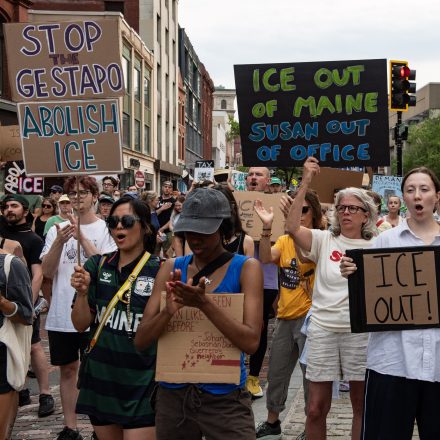
Although protesters took to the streets in Maine and Texas in the ides of summer to object to ICE’s killing of 25-year-old Johan Sebastián Durán Guerrero in Biddeford and 52-year-old Lorenzo Salgado Araujo in Houston, that glimmer of enthusiasm for action appears to have died down in the halls of Congress.
“I’ll be honest. I’m not seeing [anger] to the extent I saw when Alex and Renee were executed by ICE in Minnesota. … I’ve seen some statements come up, and some conversations, but it has not been elevated to the extent that I would expect from a number of my colleagues,” said Rep. Delia Ramirez, D-Ill. “It feels like we’re normalizing it.”
Democrats caved on DHS funding in April, and with some exceptions, most of the caucus has been silent on the existing bills to restrict the agency. Progressives have criticized their colleagues for not continuing to fight against funding the Department of Homeland Security, and for only acting in a moment of heightened political attention.
In January, Ramirez and Rep. Yvette Clarke, D-N.Y., introduced the Melt ICE Act, a bill that would end DHS funding to detain or monitor immigrants. The legislation, which Ramirez says is “not all things” but represents a meaningful step toward dismantling the entire agency, currently has 12 co-sponsors, including members of the progressive Squad and two retiring members who will leave Congress at the end of the current term.
Ramirez said she had hoped to pick up additional backing in the wake of Durán Guerrero and Salgado Araujo’s killings, but she has yet to hear from any additional co-sponsors — even from colleagues who were calling to “Abolish ICE” in February and sharing press releases with the words “Melt ICE” in them.
The Chicago congresswoman said she worried that the lack of action had to do in part with the fact that Pretti and Good were white U.S. citizens, and Durán Guerrero and Salgado Araujo were noncitizens from Colombia and Mexico, respectively. She noted that one of the first fatal ICE shootings under the second Trump administration — of undocumented Mexican immigrant Silverio Villegas González last September in Chicago — rarely gets mentioned.
“Why is it that for some, when the person seems to be lighter-skinned, a U.S. citizen, the uproar seems to be deeper?” Ramirez said. “And why was it that his name seems to be a name that many people don’t know?”
While political energy remains low, the Department of Homeland Security continues to be a lethal force. On Tuesday morning, a man in Florida running from immigration officers was struck by a semi-truck, marking the third time a person had been killed during an encounter with immigration agents within a week.
Violence has surged within detention centers as well. Within the first 500 days of Trump’s second term, 52 people have died in ICE custody, the highest mortality rate in over a decade, according to a recent report from Human Rights Watch and Physicians for Human Rights. On Monday, Jesús Manuel Arenas-Silva, a 45-year-old Venezuelan man died in a private prison used for ICE detention in Georgia in an apparent case of medical neglect.
Meanwhile, ICE has punished protesters who object to its brutality with more violence. Physicians for Human Rights and the UC Berkeley Law School’s Human Rights Center documented 412 incidents between June 2025 and May 2026 where law enforcement agents used excessive force or chemical weapons on ICE protesters, children, journalists, legal observers, and bystanders.
Dr. Rohini Haar, an adjunct professor of epidemiology at UC Berkley’s School of Public Health and lead author of the use-of-force study, said lawmakers should not allow these attacks to be met with “impunity” just because there is less impending political pressure.
“Do not ignore this just because it’s less newsworthy,” said Haahr, who is also a medical adviser for Physicians for Human Rights. “You’re going to keep getting [violence] when no one is held accountable.”

Progressives, including Ramirez, have criticized their colleagues for not anticipating that the violence would continue once DHS funding was fully restored. In April, House Democrats agreed to fund the Department of Homeland Security under a two-track model that would immediately fund most of the Department and push ICE and Border Patrol funding through a separate process that would not require any Democratic support. In June, Republicans voted to fund ICE and Border Patrol to the tune of $70 billion.
“I said this a couple of weeks ago, that I would not be surprised if, when ICE funding started up again, we would start to see more civilian deaths at the hands of ICE,” Rep. Alexandria Ocasio-Cortez, D-N.Y., who did not co-sponsor Melt ICE, told reporters on Monday. “And that’s exactly what has happened.”
The Intercept asked whether the congresswoman planned to co-sponsor Ramirez’s legislation and was directed to her public statements on the DHS funding measure. The Intercept also reached out to Progressive Caucus Chair Greg Casar, D-Texas., who is also not a co-sponsor of the legislation, to ask if he planned to co-sponsor the bill in the wake of the Texas shooting, but did not receive a response.
Although anger has bubbled up again in protests across the country, the public’s attention does appear to have waned since its peak in January after federal immigration agents fatally shot Good and Pretti.
Manisha Sinha, an American history professor at the University of Connecticut, said there are several potential reasons for lowered attention on Salgado Araujo and Durán Guerrero’s deaths. The Trump administration has changed its tactics to deemphasize cities where protesters and local leaders could jointly resist immigration enforcement, as they did in Minnesota. And, undoubtedly, the fact that “Alex Pretti and Renee Good were citizens” added to the public outrage over their killings, said Sinha.
Without the same intensity of pressure from voters as there was in winter and spring, Ramirez said many of her colleagues are not motivated to take principled positions on immigration that might anger their deep-pocketed donors. But she said she understands that people may also be wary of risking their lives while members of Congress go about their business as usual.
“People in the street don’t feel like the members on the inside really have the pulse of what’s happening to them, and that frankly they’re fucking tired,” Ramirez said. “And I hate that I have to ask them to keep showing up. But knowing this body, I know that this body only moves from pressure.”
The post In the Wake of Fatal ICE Shootings, Democrats Drag Their Feet appeared first on The Intercept.