Understanding China’s pragmatic AI optimism
- This piece originally appeared in The Ideas Letter. It has been edited for length and clarity.
Just 19 miles from the beach in Humen, southern China, where the burning of opium in 1839 started the Opium Wars and China’s “Century of Humiliation”, lies Huawei’s ornate campus at Songshan Lake. Earlier this month, when I visited Huawei, it was impossible not to marvel at just how far China had come. The campus was a stunning replica of European towns, dotted with over a hundred cafés, which appeared to convey unironically both Huawei’s global ambitions and its eagerness to learn from the West. In many of the palace-like buildings, as I peered at the technologies, it was clear that the company sits at the heart of China’s artificial intelligence boom, powering it with Ascend chips and the HarmonyOS ecosystem that underpins millions of devices and cars, all enabled by its telecoms networking gear.
More than any other Chinese company, Huawei has been the most striking symbol of the country’s resilience, resistance and subsequent triumph against Western efforts to contain and cripple China’s technological rise. In 2019, the first Trump administration added Huawei to a trade blacklist that barred US companies from selling parts to the telecommunications giant and then pushed Huawei out of America and lobbied other countries to reject it too. Such restrictions seemed like a death sentence, but none of that killed China’s development of AI. Instead, a different AI future has emerged from China, one that’s more optimistic, controlled and pragmatic than the US’s.
In China’s AI future, the shadow of the Century of Humiliation looms. When US Commerce Secretary Howard Lutnick described last year US chip exports as a way to get Chinese developers “addicted to the American technology stack”, echoes of the Opium Wars reverberated. Which is why, when companies like Huawei and DeepSeek make splashes globally, their founders are seen in China as heroes defending the country’s pride and national destiny. And why, ultimately, when everyday Chinese people think of AI, they aren’t thinking about concentrations of power and resources the way many in the West do. They remember how China was slow to industrialise during the Opium Wars and was thus plundered by foreign powers. The lesson is stark: China can either be a conqueror of technology or be conquered by others’ technology; there is no living in denial or stopping the tide of change.
“China can either be a conqueror of technology or be conquered by others’ technology.”
AI, after all, is the latest in an unending march of disruptive technologies. Some older Chinese have gone from smelting steel in backyard furnaces and eating with food ration coupons to Douyin livestreams and Alipay in less than a lifetime. AI feels just as inevitable and, may I say, even as mundane as the internet browser and the smartphone. AI feels normal.
Today, China feels profoundly more future-oriented out of necessity – it cannot afford not to keep up with the future. The cost would simply be too high. China’s economy is slowing, in the face of a collapse in property prices that has hammered household wealth, global trade headwinds for its exports, weak consumption at home and an ageing population. Beijing is hoping that new high-tech industries such as AI and robotics can fill the void left by property and set China on a path towards more modest but more sustainable growth.
In a recent Stanford University study, 84% of respondents in China said they were excited about AI, compared with only 38% in the US. Over 600 million Chinese use generative AI today, nearly 142% more than a year ago. Among ordinary Chinese, the mood is one of broad embrace, tinged with the fear of becoming obsolete if they don’t learn to master the technology fast enough. A saying inspired by Stalin and taught to Chinese schoolchildren embodies the anxiety: “Backwardness brings on beatings by others.” Feelings of pessimism are brewing in China, especially among the young, but one would still be hard-pressed to find individuals who hate AI. China is a nation of reluctant but pragmatic techno-optimists.
Imagining China as the future
The year is 2062 and the Republic of Great China is celebrating the fiftieth anniversary of its founding. The Queen of England, the Emperor of Japan, the President of Russia and other foreign dignitaries have arrived in the capital city of Nanjing for the occasion. Meanwhile, Kong Hongdao, a revered scholar who happens to be the 72nd-generation descendant of Confucius, has been invited to give a lecture on how Chinese democracy has brought the country its present prosperity and superpower status. Tens of thousands have poured in from around the world to hear him speak in Chinese, which they, naturally, all understand.
Sounds uncannily plausible? That may be because much of what this scenario envisioned has already happened, several decades before 2062. Does it also seem ludicrous and out of touch? This fantasy was penned in 1902, at a time when Qing dynasty China was still an absolute imperial monarchy and the dominant reform alternatives were republicanism and democracy – the Bolshevik Revolution was still 15 years away. The plotline comes from what is arguably China’s first, albeit unfinished, science fiction novel: Liang Qichao’s The Future of New China. Exiled in Japan in 1898 after his role in the aborted Hundred Days Reform during the Qing dynasty, Liang sought to use his visions of China-as-superpower to uplift the spirit of an entire people by imbuing them with the importance of science and technology. Such fiction allowed Chinese people to see China itself as the future, instead of locating the future outside China.
Since then, Chinese science fiction – from Han Song’s 2066: Red Star Over America to the sprawling internet epic The Morning Star of Lingao by the Industrial Party, an online community that preaches the supremacy of industrialisation – has continued to be preoccupied with the motif of China becoming a superpower through technological development or, as the academic Mingwei Song has written, “a utopian narrative that projected the political desire for China’s reform into an idealized, technologically more advanced world”.
As a kid, I remember watching the documentary series The Rise of the Great Powers, produced by CCTV, China’s national network. The series studied how nine nations rose to become great powers, drawing lessons such as the importance of industrialisation for what former president Hu Jintao once called China’s own “peaceful rise”. More recently, blockbuster films adapted from Liu Cixin’s The Three-Body Problem and The Wandering Earth have similarly venerated science, large-scale engineering and organised human effort in overcoming extinction.
This is utterly unlike the stories of Promethean urge and dystopian doom that suffuse American culture. When the average American conjures visions of AI, the most immediate images are of the T-800 striding out of the flames as its suit of flesh melts away to expose its metallic endoskeleton in The Terminator, the empathetic operating system that one man falls in love with in Her, and the rogue AI that wreaks global havoc in the latest two instalments of Mission: Impossible.
But if we trace the genealogy of AI further, the West’s fascination with machine consciousness goes as far back as Mary Shelley’s Frankenstein in 1818 and Samuel Butler’s Erewhon in 1872, as England grappled with the incursion of automation during the Industrial Revolution, which seeded feelings of human disempowerment. The dominant impulse is to battle technology as the villain and bend it to human will so as to defend the essence of human agency – agency is also at the heart of conversations about AI today in Silicon Valley, as people strive to be “high agency” instead of a non-player character (NPC) in the background of others’ video games.
It’s not easy for Americans to understand the Chinese hunger for the future, partly because it has little to do with fears around humanness. While the average American is wary of AI’s dystopian harms, particularly the erosion of human agency, the average Chinese is more motivated by the fear of deprivation – memories of poverty are still vivid for many. Humanness, therefore, can be subordinated to progress.
This is best illustrated by the hundreds of thousands of workers who manufacture iPhones, as well as the tens of millions of gig workers in China, whose lives and bodies are dictated and augmented by machines and algorithms and are constantly optimised for more efficiency and speed. I wonder if China, identifying as a developing nation, is more willing to put technological advancement over individual welfare because of the dividends that have paid off over the past four decades.
So while Virginians in the US protest the data centres in their backyards and congressional leaders like Bernie Sanders propose a moratorium on AI development, both the state and society in China feel that they can’t afford to slow down, for fear of falling back into the gravitational pull of the Century of Humiliation. In the Chinese psyche, technology isn’t an enemy that can be willed away, ignored or defeated.
Technology is the instrumentality of machines taught in One Hundred Thousand Whys, a popular Chinese science series for children. It’s the indomitable force of physical production that will revive the nation, as extolled in Marxist historical materialism; it empowers society as a collective. One could even say that China’s vision of the technological future is tainted and limited by pragmatism. It hinges on the fear of missing out on, to borrow from the country’s leaders, “the next round of techno-scientific revolution and industrial transformation”, as happened in the past, and on an obsession with avoiding the mistakes of the nineteenth century at all costs.
When technological optimism falters
Despite the futuristic positive visions of national strength, AI growth stirs discontent and is seen to have a dark side. Swept up by the vertiginous speed of technology, a sense of dislocation and resignation has enswathed many across the Pacific. Both China and the US are facing the same problem: how to balance AI growth and control. China seems to be veering closer to the middle in a bid to maintain social stability. In contrast, the US is racing full speed ahead, pursuing growth at all costs, with the goal of reaching the moment of recursive self-improvement, in which AI begets ever-smarter AI, better known as artificial general intelligence (AGI).
American efforts to regulate AI are often rebutted with invocations that an AI race is on and concerns that slowing down would handicap US companies’ ability to beat China’s and allow China to reach AGI first. This quest for AGI has whipped up a staggering amount of investment. Five leading US technology companies are expected to spend a combined $700 billion this year on AI infrastructure and other major projects – more than the United Arab Emirates’ entire economy. The US economy has also become increasingly dependent on AI, with some economists arguing that investments in AI accounted for as much as 92% of US GDP growth in the first half of 2025. American AI labs have become too big to fail.
That hasn’t made AI more popular. In March, an NBC News survey of 1,000 registered voters in the US found that the only issues with a lower net positive rating than AI were Iran and the Democratic Party. According to a Gallup poll earlier this year, even among Gen Z Americans, who are frequent users of AI, anger about the technology is rising – only 18% of respondents said they felt hopeful about it. Many have been blaming the tech oligarchs who are building the technology. In April, a young man hurled a Molotov cocktail at the home of OpenAI’s chief, Sam Altman.
Meanwhile, China is moving more cautiously, trying to balance growth and control. The Chinese Communist Party needs AI to boost productivity, drive the economy and address internal challenges such as demographic decline; at the same time, it needs to prevent AI from displacing too many jobs and fomenting social unrest. Policy elites are attuned to the possibility of social instability.
Chinese officials are advocating for an “employment-first” and “people-centred” approach to AI, framing the technology as a job creator; last year, Chinese labour arbitration authorities ruled that companies are legally required to retrain or reassign workers before they can be replaced by AI. Some experts have argued that for the past four years China has had the world’s most extensive and burdensome AI regulations, requiring developers to submit models to regulators for pre-deployment assessments and to include watermarks on AI-generated content. The push is accelerating: in the first half of 2025, China issued as many national requirements on AI as it did in the previous three years, according to Concordia AI, a Beijing-based social enterprise focused on AI safety and governance.
After all, the Chinese Communist Party’s legitimacy since Deng Xiaoping has been built on the promise of prosperity in exchange for fewer freedoms – on the promise that tomorrow will be better and living standards will keep rising. Beijing wants AI to sustain, not shatter, that unspoken bargain.
“Beijing wants AI to sustain, not shatter, that unspoken bargain.”
The Party has already reined in eat-the-rich resentment by bringing Chinese tech companies to their knees. During Covid, China’s tech entrepreneurs were caught in a years-long regulatory storm, launched in the name of reducing social inequality and curbing the disorderly expansion of capital under Xi Jinping’s “Common Prosperity” campaign.
But navigating between AI growth and control won’t be easy. During my trip this month, I sensed a growing awareness among Chinese people about the impact of AI on jobs, though for many it hasn’t yet brimmed over into fear. Many are curious about America’s AI bubble, about the rise of AI coding and its impact on software engineers, and the yawning inequality caused by the unprecedented amount of wealth that will be minted with the upcoming IPOs of US frontier labs this year.
To me, China feels about a year or so behind the US in where it’s at on the technology and in hype. There is less grandiose fanfare about AI’s capabilities and less visible concentration of wealth, and the AGI moment does not feel imminent for the vast majority. No wonder fears around AI-induced labour displacement seem milder in China than in the US, even though China’s economy and job market are doing worse overall. But it remains to be seen whether the more positive zeitgeist in China will hold in a year or two if there are more large-scale layoffs in the tech industry, though it seems likely that the government would step in to minimise that.
For now, in post-boom China, the new normal is stagnating salaries, a challenging job market, collapsing property prices and involution across sectors – none of which is perceived as directly caused by AI. Tired of running faster towards an uncertain future, some workers are lying flat and opting out of the forward-looking grand narrative of state progress. A tiny exhalation of freedom under the panopticon of authoritarian control.
And a few have attempted to vehemently resist the technological onslaught. In 2024, taxi drivers in Wuhan protested against Baidu’s robotaxis, capturing national attention. In a letter, they argued that street-hailed taxis were “on the brink of extinction”. Although the message went viral, the protests couldn’t stop the rollout of self-driving cars across Chinese cities. As China plunges headfirst into its national vision of technological ascendancy, most in society are still scampering ahead, hopeful that AI will fulfil the promise of rejuvenation.
China’s future is haunted by its past
Last year, during a brief stop in Shenzhen, I wandered around the Window of the World, which in the 1990s was the hottest sightseeing spot in town and now feels more like an obsolete parody. I hopped across the scaled-down Great Wall, peered at the pint-sized pyramids of Giza not far away from the carved faces of Mount Rushmore, and gazed at a mini Mount Fuji set against skyscrapers thrusting into the blue sky.
The now-empty theme park had a laid-back, faded charm, self-aware that it belonged to an age that’s past. I could imagine how, when it first opened, the boulevards must have thronged with Chinese tourists who were eager to see the world but lacked the means to travel abroad. At one point, these little arcadias of globalisation sprouted all over China, with more than 2,500 built between 1990 and 2005.
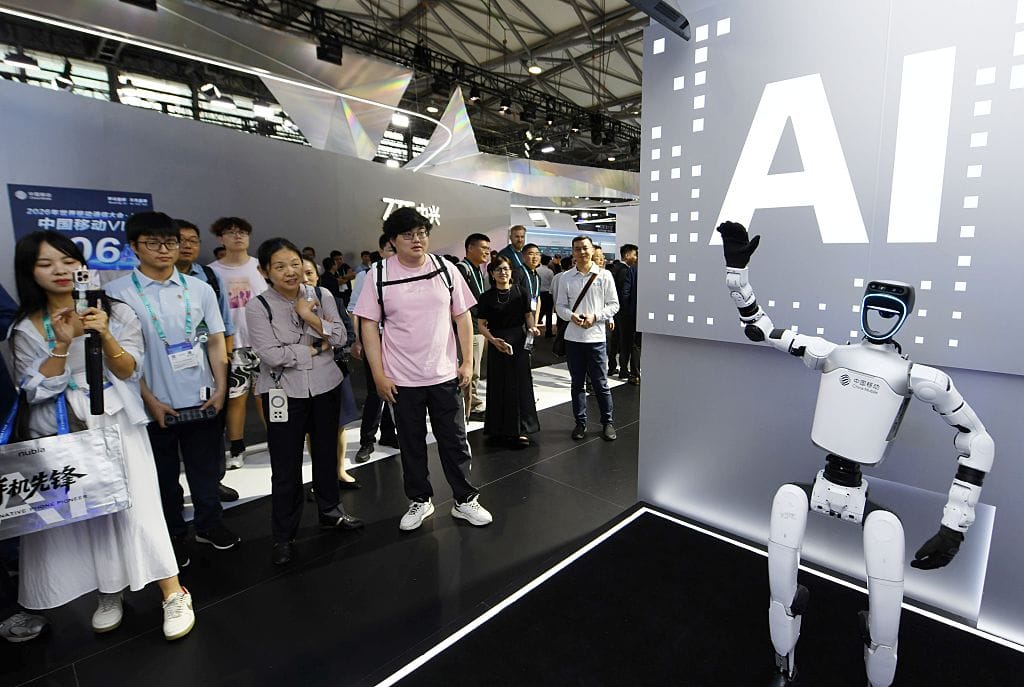
Today, parks like the Window of the World no longer hold the Chinese in thrall. The surrounding cityscapes now embody a hyper-modernity that lures foreign tourists. Metropolises of tomorrow like Shenzhen and Chongqing resemble another kind of gigantic theme park, representing fantastic ideas of the future. Western influencers and executives make the pilgrimage to Chinese cities to experience food delivery by drone, fancy EVs, high-speed rail, tri-fold phones and dancing humanoid robots. This is yet another manifestation of what I’ve called “Sinofuturism”.
But what strikes me most as I travel to China year after year is how the arc of history weighs on the Chinese present. Many people in the West cannot fathom how it actually feels to have lived through the last 40 years since Reform and Opening Up. Many successful middle-aged Chinese tech entrepreneurs I met this month spoke of memories of famine and hunger, of growing up eating meat once a year, of earning only $10 per month even as a university graduate, and of the destructive upheaval of the Cultural Revolution.
These are the elites who are currently steering China’s AI future. Their most potent fear about AI is that it might tip society back into the poverty and chaos of the not-so-distant past – whether through embracing AI too slowly or too fast.
From everyday Chinese, I sense a mix of nationalism, optimism and apathy. They want AI to be good, to make their lives better, to keep driving China’s economic engine. Some 451 million Chinese live in rural areas, with less access to quality education and healthcare. In 2025, China’s GDP per capita was around $14,000, less than one-sixth of the US’s. But the country’s population is shrinking and ageing fast; the working-age population peaked in 2015.
AI, then, cannot be ignored and must be learned. Most understand that China does not yet have the luxury to choose not to grow. Even many of the more sceptical in China, instead of imagining liberating alternatives to technology as many do in the West, shrug their shoulders and entrust such imaginations to the Party, which promises that only it can steer the country towards fulfilling the mission of “national rejuvenation”. The price of revolution is more fatal in China.
Still, one ought to be careful not to brush aside China’s vision of AI as a static monolith. As in the US, dreams and nightmares jostle constantly. Under the Chinese top-down visions of AI – as a technology that will propel the nation and society forward, will be a panacea for domestic challenges, and will heal the scars of the Century of Humiliation – the Chinese people have their own desires, innovations and subversions that contest and shape the state’s visions.
I think of the women who date AI boyfriends and refuse to marry real men, the widespread criticism of the streaming giant iQIYI for licensing the likenesses of real actors for AI-generated shows, the DeepSeek moment that sparked a bottom-up open-source movement in China, and a recent government regulation that bans virtual companions for minors. The future doesn’t arrive without friction.