California can’t replant its forests fast enough to keep up with wildfires
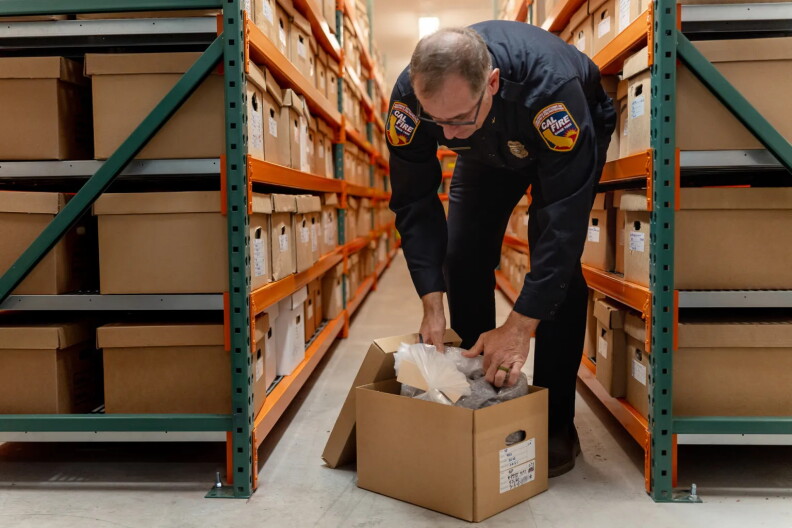
A windowless warehouse on the outskirts of Davis shelters pieces of California’s forests.
Icy air swirls and fogs around 42,000 pounds of seeds — the past and the future of these trees, frozen in cardboard boxes. It smells like the woods on a snowy day.
“This is like the mothership of forestry in California right here,” said Stewart McMorrow, staff chief for wildfire resilience at Cal Fire, standing outside the heavy metal door of the state seed bank at Cal Fire’s Lewis A. Moran Reforestation Center in Davis.
Private landowners especially rely on these seeds — some now more than a half-century old — to reforest property destroyed by wildfire.
At the pace California is burning, it’s nowhere near enough.
Climate change and more than a century of overzealous fire suppression are now fueling wildfires so severe that they’re wiping out the very forests that need fire to thrive — leaving iconic landscapes at risk of turning into brush and scrub, permanently.
Over the past quarter century, high-severity wildfires have burned 2.3 million acres of California’s forestland so completely that the trees are unlikely to return on their own — according to a working draft of the state’s new reforestation strategy obtained by CalMatters.
California is counting on these forests to store carbon, protect water supplies, clean the air, and shelter wildlife. By 2071, one recent analysis reports, half of California’s forest area could be gone.
“Reforestation,” said Malcolm North, a scientist with the U.S. Forest Service Pacific Southwest Research Station, “is pretty damn important.”
Yet to replant even a quarter of the privately owned forestlands in the state, California would need to increase seed bank capacity by roughly 300%, according to Cal Fire — which means more seeds, more people, more space. And that wouldn’t solve the problem on federal land, which accounts for more than half the forests in the state and most of the lands that need replanting.
CalMatters reviewed a working draft of California’s reforestation strategy; the USDA California Climate Hub is developing it with state and federal agencies, the conservation non-profit American Forests, and the Governor’s Wildfire and Forest Resilience Task Force.
But both Sacramento and Washington have spent decades letting the money and staff needed to grow back California’s forests wither.
“We need to focus on reforestation as an emergency, as a state,” McMorrow said. “We are slowly losing our forestland, and we’re not catching up.”
Bleeding the federal workforce
Timber harvests once paid for much of the U.S. Forest Service’s efforts to replant trees.
But as new laws tightened endangered species and other public lands protections, logging in national forests declined. Severe wildfires also increased.
The combination devoured the Forest Service’s resources, and people: from 1998 to 2015, non-fire staff tasked with managing National Forest System lands decreased by 39%, according to a 2015 report.
With ever-increasing demands, a 2022 Forest Service document warned, there is a “critical need” to increase the number of staff “substantially dedicated” to reforestation.
Congress and the Biden Administration unstoppered additional money for a reforestation trust fund in 2021, a move championed by the conservation non-profit American Forests. Just a few years later, the Forest Service reported that it had replanted roughly 285,000 acres nationwide — the highest yearly total in more than a quarter century.
But the need still dwarfs action, and federally-directed work is lengthy and intense. Crews must clear dead and dying trees quickly to reduce the danger to people and the chance of reburns, a Forest Service spokesperson said. Finding seeds and growing seedlings can take a year or two, even before planting.
The federal government’s capacity to replant forests eroded away over time, and it will take time to rebuild it, said Solomon Dobrowski, a professor of landscape ecology at the University of Montana. Dobrowski’s research found that the reforestation gap spans millions of acres across the West and is likely to double or even triple in the coming decades.
“You don’t turn that ship around on a dime,” Dobrowski said.
Instead, the Trump administration cut the Forest Service significantly. The agency lost 20% of its staff last year.
“It just makes me cry at night … it’s basically a child swinging a wrecking ball,” said Hugh Safford, a forest and fire ecologist with the UC Davis Environmental Science and Policy Department and a former regional ecologist for the Forest Service. “Morale is down, capacity already was really minimal.”
And California keeps burning.
A widening gap
The loss of forests “is one of the least-known impacts of climate change and megafires,” said wildfire task force director Patrick Wright.
The draft strategy for California obtained by CalMatters comes with no dedicated funding. The goal, Wright said, is to put every agency and organization trying to replant California’s scorched forests on the same page.
The strategy calls for streamlining planning, prioritizing projects tackling critical human safety concerns and ecosystem issues like water supply, and increasing the supply of seeds, seedlings and workers.
It urges land managers to avoid adding more fuel to the fires, and recommends replanting at lower densities and with more natural spacing instead of the classic, closely-packed “pines in lines” grid. Scientists have linked high-density plantings to high-severity fires.
The most startling pieces, though, come from the draft strategy’s look at the current landscape. California would need to scale up reforestation by 35% annually to meet the state’s existing post-fire replanting goals, which start at 280,000 acres per year in 2030. The increase would take “significant funds,” the report said, because reforestation can cost up to $6,400 an acre.
But the current pace is lagging. Statewide, land managers have replanted roughly 254,000 acres of severely burned forest since 2020 — or around 16% of the area stripped of forest cover by high severity fires between 2020 and 2024 alone. The number is just 8% on federal lands, outside of wilderness areas.
Safford said the numbers are actually even more dire: Factoring in both wilderness areas and excluding forests likely to regrow on their own, his recent study reports that the U.S. Forest Service replanted just 1.2% of the agency’s California lands that wildfire denuded between 2016 and 2023.
It wasn’t always like this, said Safford. The Forest Service’s replanting efforts mostly kept pace with wildfires until around 2006.
“And then,” Safford said, “it just falls to shit.”
‘Nowhere near prepared’
For all the vitriol between Gov. Gavin Newsom and President Donald Trump over the care and raking of California’s forests, state and federal money — and people — often intersect on the landscape.
On California’s end, Cal Fire funds and conducts research, and provides grants for forest restoration on private, state and even federal land. Cal Fire also runs the reforestation center in Davis, where flats of glossy young conifers are gently misted with water in the summer heat.
McMorrow — tall and crisp in his navy Cal Fire uniform — can’t help but dig his hands into the dirt to pull out weeds tangling with the seedlings.
One of the most challenging chokepoints, McMorrow said, is finding the right seeds to grow these seedlings — getting climbers to the right spot, at the right time, to pluck ripe cones from the treetops.
“Believe me, I do it,” said McMorrow, who created a tree-climbing program at Cal Fire. “We are trying to meet the demand that’s in front of us, and it’s crushing.”
Yet the money for Cal Fire’s efforts — cobbled together from the state budget, federal grants and other one-time funds — represents a relatively small and ever-changing fraction of Cal Fire’s multibillion-dollar budget.
The nursery in Davis shut down in the early 2000s, a casualty of across-the-board state budget cuts. Though the seed bank freezer stayed on, the reforestation center didn’t fully reopen until after the Legislature in 2017 tapped a 2012 fee on wood products to bring it back online.
Scaling up and upgrading the facility now carries an estimated $26.2 million price tag; this year’s state budget included about $1.2 million to fund preliminary planning.
Meanwhile, other funding is on the line. California’s climate regulators — chaired by Newsom appointee Lauren Sanchez — voted in May to overhaul a key climate program in ways that could substantially reduce, or even eliminate, up to $200 million a year for wildfire resilience. Grants for reforestation are among the many competing priorities for this funding.
While the Proposition 4 climate bond includes $1.5 billion for wildfire and forest resilience, state leaders are spending down the bond quickly.
“The truth of the matter is that California is probably, infrastructurally speaking, in a better place than any other western state,” Safford said.
“What that tells you is how piss-poor the capacity is in general in the Western U.S., because California is nowhere near prepared for the scale of this.”
Cone hunting
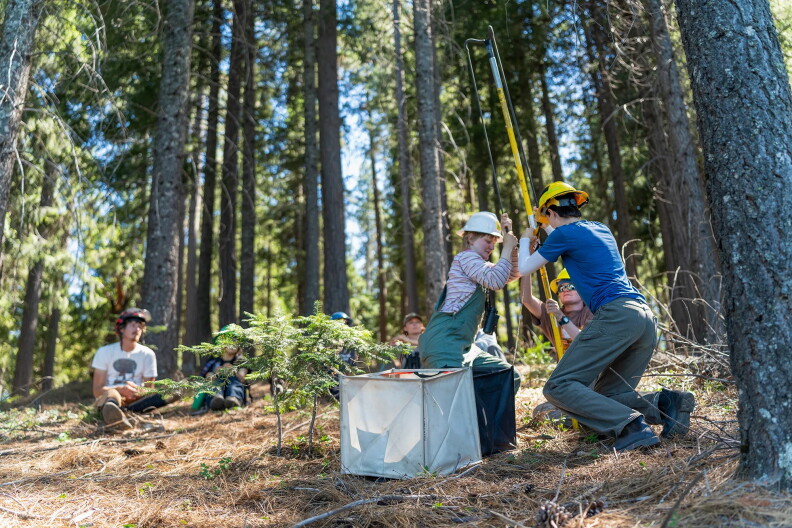
On the banks of Jenkinson Lake in the Sierra Nevada foothills, Stella Krone and Elyse Wohlenberg wrestled with a slingshot that towered over the two of them. It took their combined strength to slot the bungee into position, then Wohlenberg stepped back.
“All clear?” Krone asked, kneeling in a clearing and pointing the slingshot at a Douglas fir 50 yards away. “Firing!”
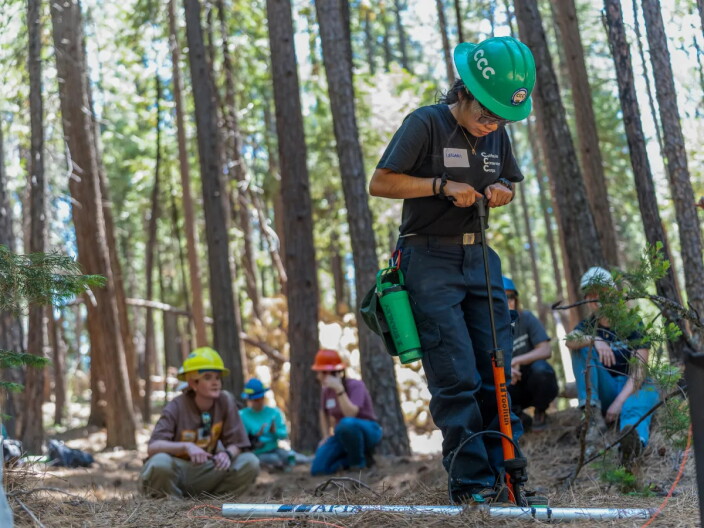
Krone, Wohlenberg, and dozens of other hard-hatted people were there, crunching over conifer needles, for Cone Camp — a training program led by American Forests with support from Cal Fire and the Forest Service.
The campers — some forestry professionals, some interested laypeople — peeled off with oversized slingshots and souped-up potato guns to learn how to knock cones loose from tree branches. That’s how they check the cones for ripeness and viability, before sending someone up the tree to collect them for a seed bank.
The problem was, there were hardly any. Last year’s dry cones rattled to the forest floor as Krone and another camper jiggled the rope they’d shot into the canopy.
“So far, not a great cone year,” said Leana Weissberg, American Forests’ California director.
In the clearing, the instructor asked whether the group was ready to try again.
“Let’s go,” Krone said. “We’re cone hunters for a reason.”