Blank cheques. The problem and the fix for the NDIS

Billions of dollars are spent on capital items such as assistive technology, home renovations and vehicle upgrades for NDIS clients, without oversight. Claudia Weisenberger reports.
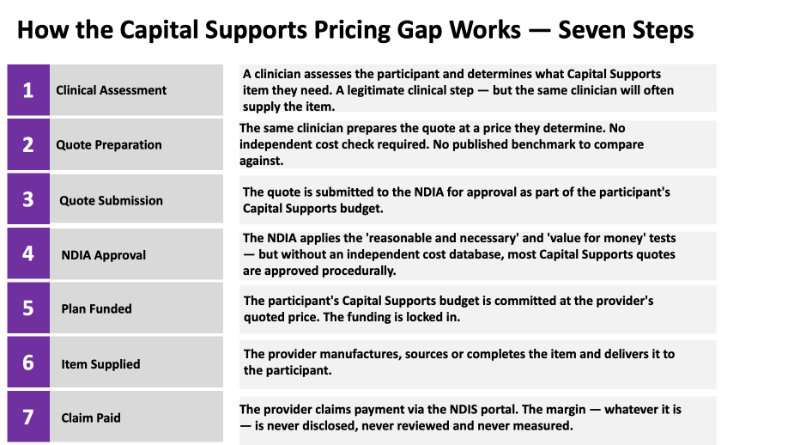
A podiatrist has just completed an assessment. The patient is an NDIS participant who needs custom orthotics. In the next few minutes, the same podiatrist will prepare a quote, set the price, and submit it to the NDIA for approval.
There is no published benchmark for what those orthotics should cost. The NDIA will approve the quote with no independent verification, and the participant’s plan budget absorbs the full cost.
As a support coordinator told ABC’s Four Corners, “It’s actually very easy to overcharge… Nobody is verifying that the actual work was done.”
Finite budget, infinite spending
An NDIS client’s budget is finite. If an overpriced pair of orthotics consumes a disproportionate share of a participant’s Capital Supports allocation, there may be nothing left for the wheelchair assessment, the home modification, or the communication device they also need.
The overpricing is invisible to the participant — but its consequences are not.
This is not a rogue operator. It is a structural feature of the NDIS Capital Supports budget — a category covering custom disability equipment, home modifications and vehicle adaptations for approximately 274,000 Australians annually — representing 36% of all NDIS participants. What follows is not fraud. It is the system working exactly as designed.
Gap in the framework
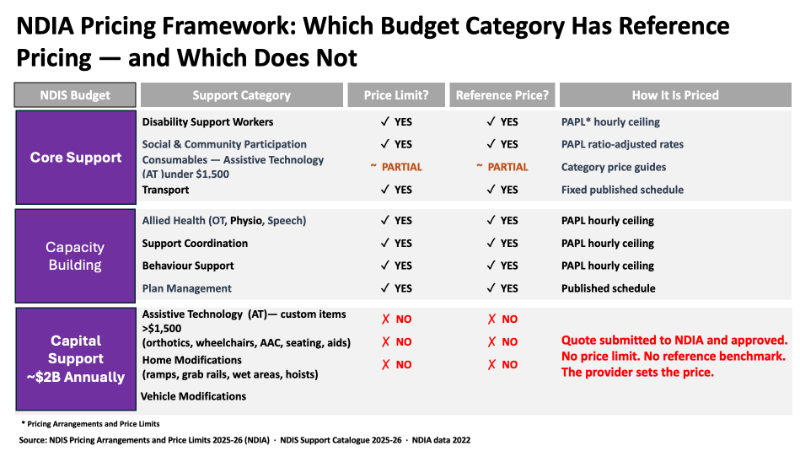
The NDIS funds support across three budget categories.
- Core Supports covers the day-to-day assistance participants need — disability support workers, social and community participation, transport and consumables.
- Capacity Building Supports covers therapy, support coordination, behaviour support and plan management.
For both the Core Support and Capacity Building categories, the government publishes firm annual price ceilings. A physiotherapist cannot charge more than $183.99 per hour. A disability support worker cannot exceed $70.23 per hour on a weekday. These are hard limits, publicly available and independently reviewed.
- Capital Supports — covering assistive technology, home modifications and vehicle modifications — has no equivalent. No price limits. No published reference prices. A provider submits a quote; the NDIA assesses it against a ‘reasonable and necessary’ standard; and the quote is approved. The provider’s own figure is the only reference point in the transaction.
Capital Supports has none of these guardrails.
The mechanism is the same whether the item is a pair of orthotics, a powered wheelchair, a bathroom modification or a vehicle adaptation. Seven steps, no published benchmark, no independent cost verification at any stage:
Assistive technology overpricing
Five structural features make Capital Supports overpricing invisible. The two most significant reinforce each other.
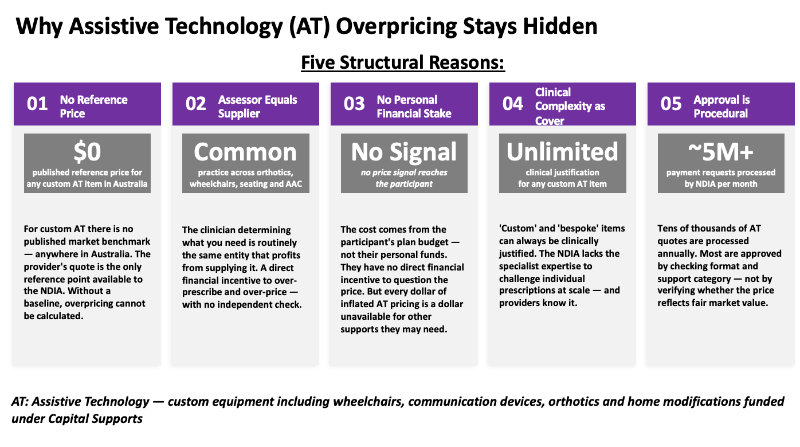
The pricing gap persists because two features of Capital Supports reinforce each other.
The first flaw is a conflict of interest built into the assessment process. In parts of the Assistive Technology sector — particularly orthotics, prosthetics and specialised seating — the clinician who determines what a participant needs is routinely the same entity that supplies it and profits from the transaction. The more expensive the prescription, the larger the claim.
The NDIA’s 2025-26 Pricing Arrangements added a conflict-of-interest declaration requirement — a notable acknowledgement that the problem exists, more than a decade after the scheme launched.
The second flaw compounds the first. The participant’s plan budget absorbs the full cost — nothing comes from their own pocket. Without a personal financial stake in the transaction, most participants have no practical means of knowing whether the price is fair, or whether the benchmark that would tell them simply does not exist.
Each flaw alone would be manageable. Together they are not — because the only party that could object has no reason to, and the only party that could check has no benchmark to check against.
The scale of the problem
According to the Australian Institute of Health and Welfare, 36% of NDIS participants — approximately 274,000 Australians — received assistive technology supports in 2024-25. Add home modifications and vehicle modifications, and the total Capital Supports recipient base is higher still. Across the category, the NDIS spends approximately $2B annually.
The NDIA’s Integrity Chief confirmed to a parliamentary inquiry in May 2026 that there is no statistically valid way to measure how much of the scheme’s leakage is due to fraud. For Capital Supports, the problem goes further — structural overpricing is legal and generates no fraud statistics at all. The money disappears into the gap between what things cost and what providers charge.
Without a published reference price, nobody can calculate how wide that gap is.
The NDIS does not publish granular expenditure data for Capital Supports at the item level. Without it, neither the NDIA nor independent analysts can calculate how wide the gap between market cost and actual claims actually is. The first step toward a reference pricing framework is not building one — it is releasing the data that would show how urgently one is needed.
The fix
The solution is straightforward in principle: a published reference pricing framework for Capital Supports items, built from market data, updated annually and integrated into the NDIA’s pre-payment claims process.
New Zealand’s disability support system publishes reference prices for disability equipment and home modifications — giving the regulator an independent basis to assess whether a quoted price is reasonable before payment is released. Australia’s NDIS, after thirteen years and a scheme now forecast to cost $54B in 2026-27, has built nothing equivalent.
There is no published cost database for a custom orthotic, a powered wheelchair, a bathroom modification or a vehicle adaptation. The provider’s quote remains the only reference point available to the NDIA, for approaching $2B in annual spending. Until those changes are made, the gap between what Capital Supports items cost and what the NDIA pays for them will remain impossible to measure — and impossible to close.
The NDIA knows this. The Productivity Commission identified it. Parliament has been told about it. The benchmark infrastructure has simply never been built.