Australian children’s classics: Storm Boy’s tough, tender ode to wild childhood will make you cry
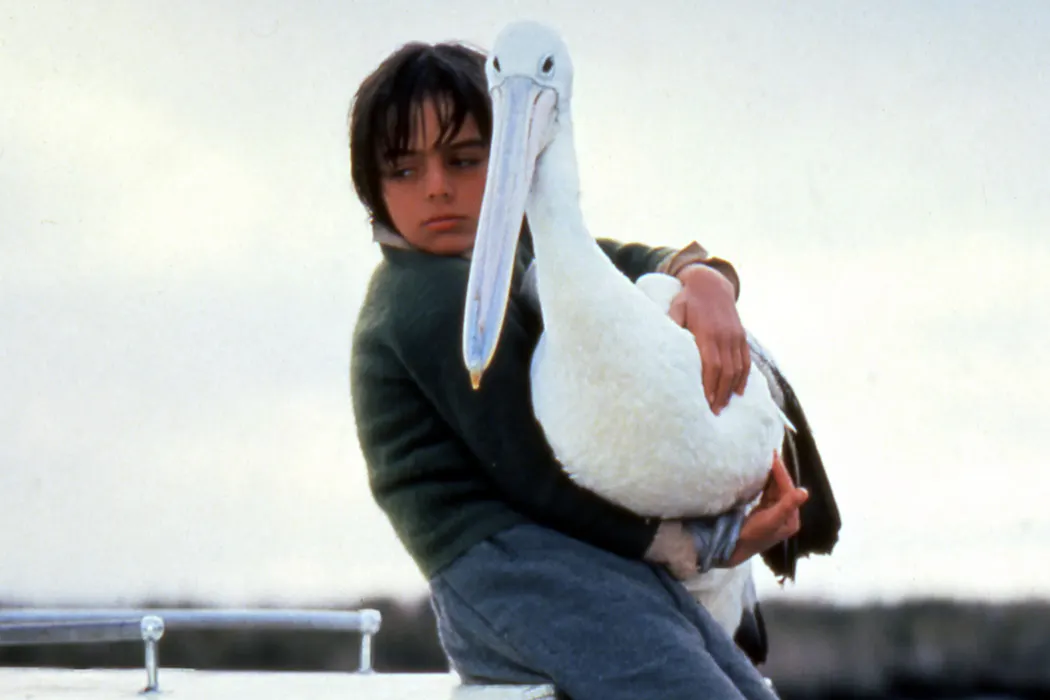
Storm Boy, Colin Thiele’s much-loved classic, has never been out of print. Its iconic 1976 film version, with David Gulpilil as Fingerbone, turns 50 this year – and it has long been hailed one of Australia’s greatest books. On publication in 1963, the Times Literary Supplement argued for it to earn a place among the few “lasting children’s classics”.
Storm Boy, whose mother is dead, lives with his father, an isolated man called Hide-Away Tom, close to nature on South Australia’s Coorong, a spectacular saline lagoon and wetland of international significance. Storm Boy befriends Ngarrindjeri man Fingerbone Bill, who becomes his mentor and guide when he rescues three pelican chicks. Storm Boy becomes close to one of the pelicans, Mr Percival – until the outside world violently intervenes.
The books we read as children can shape us forever – as readers and people.
In this series, we asked experts to reflect on some of Australia’s most beloved children’s classics, spanning the 19th century to the new millennium.
Thiele loved the Coorong. Home to more than 200 bird species, it sits where the Murray River meets the Southern Ocean, protected from it by sand dunes and windswept beaches. Alarms have recently been raised about the threat of bird flu to the thousands of pelicans for whom the Coorong is an important breeding sanctuary.
“A wild strip it is, windswept and tussocky, with the flat shallow water of the Coorong on one side and the endless slam of the Southern Ocean on the other,” he wrote of Storm Boy’s home in the book’s opening passage. Conservation and protection of the environment would be themes in many of his more than 100 books, most of them for children.
Thiele died in 2006, aged 85. Still universally popular, Storm Boy conveys wisdom and enduring life lessons, without being in any way didactic.
Fragile men, wild landscape
“It’s about very fragile men in a rough and wild landscape withdrawn from society because of traumatic events in their lives,” said director John Sheedy of the beloved book in 2015, when his Sydney Theatre Company stage production, using puppets for the pelicans, showed in Melbourne. Storm Boy has often been adapted for stage and screen, including as a second film, in 2019.

Michael Trealor Antiquarian Booksellers
Thiele created Storm Boy after his friend, artist John Bailey, described a story he wanted Thiele to write, so he could illustrate it (which he did): about a lonely boy on the Coorong, titled Storm Boy. Thiele was influenced by hearing about vandals in the area who had killed birds and destroyed their nests. The resulting book was 50 pages long. He refused a publisher’s request to expand it.
“They say that all of us have known only one child in our lives – the child we once were,” said Thiele, who described the German immigrant Barossa Valley farming community where he grew up as “an enveloping world of solitude – but never loneliness”.
Many of Thiele’s books are influenced by this background. His household was German-speaking and it was not until he went to school that he spoke English, a language in which he soon became fluent and literate. He enjoyed writing in English “from an early age”. It was a childhood he vividly described in his autobiography, With Dew on My Boots.
In tune with Country and nature
Fingerbone Bill gives Storm Boy his nickname and teaches him about Country: importantly, helping him raise the orphaned pelican chicks. Thiele’s respect for Australia’s First Nations peoples is conveyed in many of his books, including this one. Fingerbone Bill’s wisdom and affinity to the land and waterways is “an acknowledgement of Ngarrindjeri habitation of the lower Murray River, Lower Lakes and Coorong”.

Wikipedia
Actor Trevor Jamieson, who played Fingerbone in a Perth production of Storm Boy, described the 1976 film as life-changing for its depiction of the character. “Back then, it was incredible to have any Indigenous character at all,” he told the Sydney Morning Herald in 2013. “In Storm Boy, the characters are all equals. You have Fingerbone Bill, the father, the boy and the pelican … It is really beautiful.”
The book celebrates being in tune with nature. Storm Boy does not go to school; the natural world is his school, his playground and where he feels at home. He learns from his experiences – the kind of education Enlightenment philosopher Jean-Jacques Rousseau famously believed in. Storm Boy has a classic Roussuean upbringing: he has, “lived the life of a child”.
The book and film evoke a kind of nostalgia for a romantic, rural childhood where the child is free to roam and to be a part of the natural world: a world which, whether literally true or not, is seen as the proper place of childhood. In a sense, too, the life Storm Boy and his father live appeals to the Australian bush myth of independence, closeness to the land and a kind of pioneering spirit.
‘I will … NEVER kill a pelican’
As Storm Boy is motherless, the natural world also becomes his nurturer, as he himself learns to be when the adult world encroaches on his idyllic lifestyle and he finds the three pelican chicks, whose mother has been shot. This senseless act by men is a clear contrast with the “naturalness” of the child Storm Boy, who is able to understand and respect the ways of nature.
The innocence of childhood is corrupted and the outside world intrudes. The child becomes both carer and teacher. Through him, we understand the importance of conservation and respect for wildlife.
Mr Percival is a central figure – and even heroic, when he flies out to a stricken boat with a rope to secure it. Further devastation comes, however, when Mr Percival is shot. However hard he tries, Storm Boy cannot save him. He and his father bury the bird in the sand dunes.
One definition of “the very best children’s books” is that they “don’t talk down to kids”. Thiele certainly subscribed to this – and his description of Mr Percival’s death is poignant.
The bird has been trying to protect other birds from the hunters, but to no avail.
Mr Percival seemed to shudder in flight as if he’d flown into a wall of glass. Then he started to fall heavily and awkwardly to the ground. […] When Storm Boy reached him he was trying to stand up and walk, but he fell forward helplessly with one wing splayed out.
However many times I read this passage, I cannot help but be moved. Thiele himself shared reader reactions, from both adults and children. “Storm Boy has a lump in his throat and I did too.” And: “our librarian read Storm Boy to us and she started crying. She told us that every time she reads it she cries.”
One boy from Canberra wrote (with increasing emphasis): “Mr Thiele I will never, NEVER, NEVER kill a pelican.”
Storm Boy himself has become an iconic figure in Australian children’s literature – and the book is one of those wonderful stories that lives with you long after you have closed the final page.

Margot Hillel does not work for, consult, own shares in or receive funding from any company or organisation that would benefit from this article, and has disclosed no relevant affiliations beyond their academic appointment.