Arizona voters won’t get to rein in vouchers. Don’t tell us they all love it.
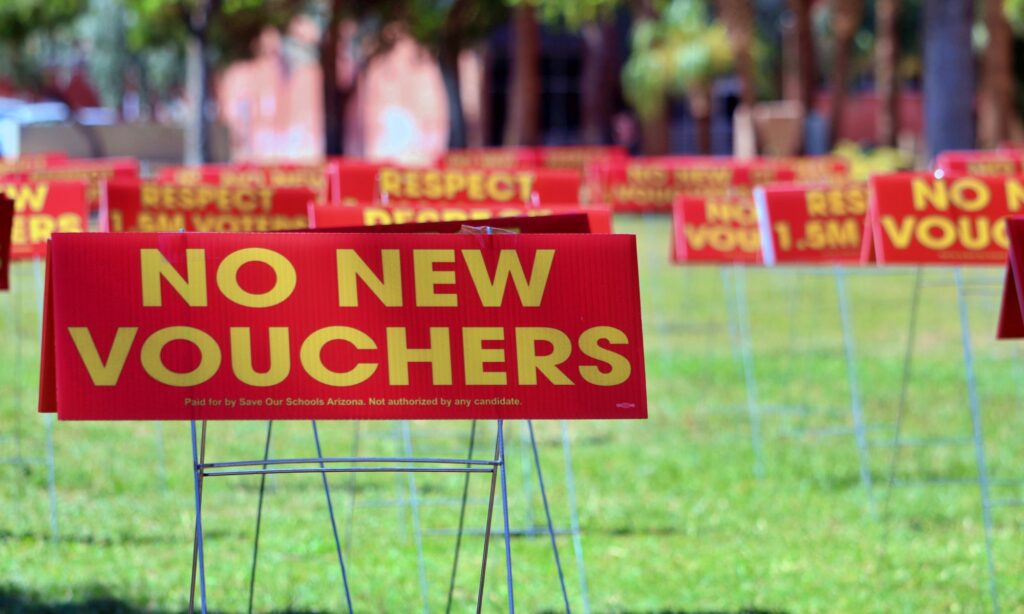
Save Our Schools Arizona filled the lawn outside the Arizona House of Representatives denouncing a Republican plan to expand Empowerment Scholarship Account vouchers to all Arizona students on June 22, 2022. (Photo by Jerod MacDonald-Evoy/Arizona Mirror)
Arizona school vouchers that are pulling $1 billion away from students in K-12 public schools are here to stay, whether we like it or not.
And, unfortunately, they’ll stay with no real oversight that taxpayers like me might expect, leaving parents with remarkable discretion over how our public money is spent.
What are we supposed to do about it now?
Elect “pro-education candidates,’’ suggest the groups that tried but failed to give voters a chance to impose new restrictions, including a $150,000 household income cap.
That gives me little comfort that questionable spending on luxury items like electric dirt bikes, watches and Yeti coolers will be reined in without accountability.
This week, the state’s Supreme Court ended the only chance voters had this year to weigh in on those proposed restrictions when it upheld the formula a lower court judge used to evaluate whether the voter signatures backers gathered were enough to qualify it for the ballot.
The result of the legal interpretation and math means that the Protect Education Accountable Now committee failed to submit enough valid signatures. That means the Protect Education Act, which would have tightened eligibility requirements and spending rules for the Arizona’s Empowerment Scholarship Account program, won’t be on November’s ballot.
“Prop. 212 would have protected students and returned money to our underfunded public schools,” AEA President Marisol Garcia said in a statement.
Former Republican Gov. Doug Ducey, who signed the universal ESA program into law, celebrated the court’s ruling as a “sigh of relief for tens of thousands of parents and students.”
“Arizonans overwhelmingly embrace school choice and will continue to do so, regardless of how many millions of dollars these groups waste trying to take it away,” he added.
There’s no point of arguing the merits of vouchers anymore. But let’s not rewrite history about what Arizona voters actually said.
Has Ducey forgotten that voters rejected a major expansion of the voucher program when they were given the chance? And that he and Republican lawmakers later enacted a universal expansion anyway?
That’s worth discussing. When voters spoke directly on the issue, they said no.
Now voters won’t even get the chance to decide whether the program needs tighter guardrails.
A quick trip down memory lane explains how we got here.
In 2011, lawmakers created ESAs for a limited group of students, including children with disabilities. Critics sued, arguing the program violated provisions of the Arizona Constitution barring certain uses of public money for private or religious institutions.
In 2013, the court of appeals upheld the program. It concluded the money was put into accounts managed by a parent who decides how to spend the money rather than directly giving it to private schools.
Then came the first major expansion.
In 2017, Ducey signed legislation expanding ESA eligibility to every student in Arizona. Public school advocates successfully forced the issue onto the 2018 ballot as Prop. 305.
Almost 65% of voters voted to reject the measure, blocking the expansion.
But four years later, Ducey signed a new bill making every K-12 student eligible for vouchers and making Arizona the first state to offer a universal ESA program.
We don’t know if voters in 2026 would have done what they did in 2018, when they overwhelmingly rejected a voucher system with minimal oversight. But neither does Ducey, whose assertion that “Arizonans overwhelmingly embrace” vouchers won’t actually be put to the test.
The record is more complicated than that. Voters rejected the expansion, which exists only because lawmakers and Ducey ignored their wishes.
At this point, we can debate who benefits and who doesn’t, but don’t tell us the system is universally liked and loved.
It isn’t.
Again, vouchers are here to stay. But what do we do with the underfunded public schools designed to educate every child, regardless of ZIP code, income, disability or family circumstances?
That’s the bigger challenge facing Arizona now. If that system isn’t working, then fix it. Reform it. Demand accountability.
And our task as taxpayers is also to remain vigilant and demand accountability of the loosely regulated voucher system that lets parents exploit it. It really is just up to us.