Andrew Sean Greer: ‘Everything’s terrifying to me—even buying a stick of gum’
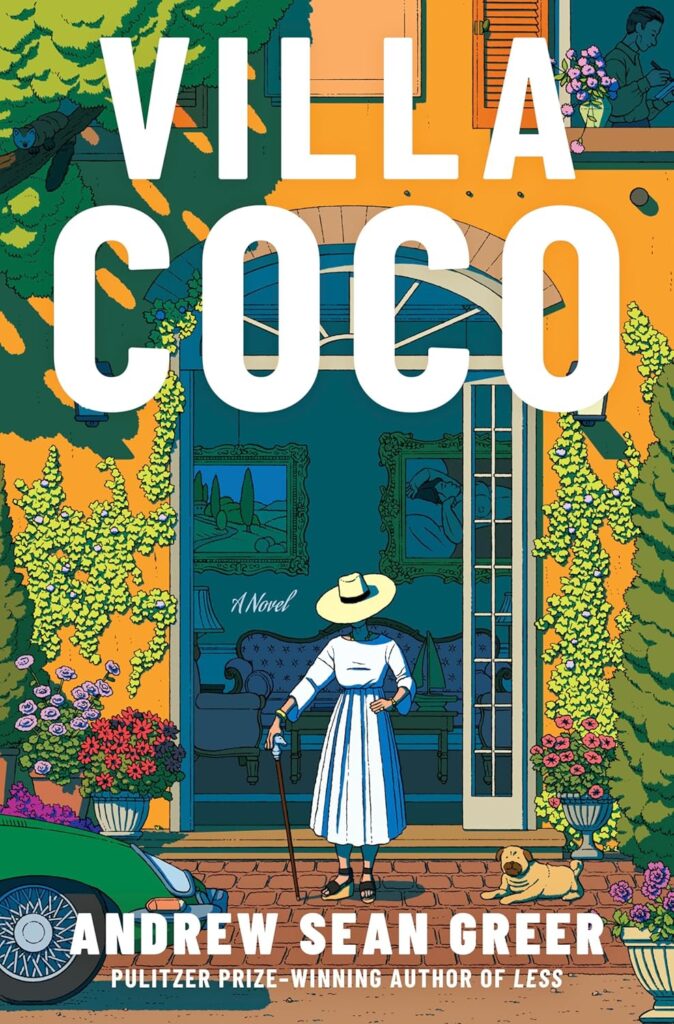
Andrew Sean Greer’s eighth novel, Villa Coco (Doubleday), performs a duet. Like recent notable books by local authors (Ayelet Waldman, Dave Eggers), the story is told by a single narrator. Even so, the Pulitzer Prize-winning author’s “hidden” voice and the book’s quiet significance sings in stereo.
Greer’s novel is set in Tuscany, where Geoffrey, a 21-year-old American archivist, has arrived as the “adjutant” to a 92-year-old Baronessa. Charged with cataloguing her highly eclectic, ephemeral art and artifacts, he instead finds himself asked to attend to the rose garden, search for a septic tank, arrange veterinarian appointments, steal an urn containing her nephew’s cremains at his funeral, and more. It is a hilarious romp through Italy’s history and culture that somehow weaves in American naïveté, a wayward marten, monomaniacal consumption of artichokes, plus an Italian princess, a lover, and a spider with ballerina-like pink legs.
While revealing the foibles of its characters and the protagonist’s fear of the emerging truth about his life, Villa Coco establishes itself as a coming-of-age tale. Greer’s writing is often humorous and like most of his previous novels (Less and Less is Lost, in particular), it is filled with delightful details. There are paragraph-long, read-twice-for-pleasure descriptions of meals, artwork, and people.
But riding along is a dueling banjo; Greer’s sneakily profound exploration of aging, war, and the complexities of love. Encompassing both people and places, Greer addresses love found, sacrificed, claimed, treasured, remembered, forgotten. In the most climactic scenes, what he classifies as a charm novel oscillates between that genre’s light, farcical comedy and the atonal, disharmony found in life’s weighty events.
I don’t want to risk spoiling a reader’s encounter by saying more. I caught Greer at the end of his US book tour in June. He was the next day jumping on a plane to Venice, where he maintains a second home and would complete the international leg of his promotional rounds. Our conversation began with my asking about scaring himself and the role it played in the books he writes and reads.
“I love that you asked that, because it’s a large part of my life. I am the most fearful person. Everything’s terrifying to me; buying a stick of gum, ordering a bagel, tipping a pizza person, becoming a novelist. There’s no safety. Choosing what I write about is all free-fall. I keep hoping this exposure therapy makes me immune, but it doesn’t work.”
Unlike the characters in his book who might otherwise be buttoned-up and organized people, yet who are often forced by life to exist like untethered mylar balloons on a blustery day, Greer is highly disciplined in his writing practices. Starting with his famed Less, his practice has been to write one scene completely. Once he understands it, he writes more scenes, followed by “the hard part” of figuring out how it all goes together. “I allow anything to happen, then I don’t,” he says.
Novels he admires and aspires to write offer serious expression but are also terrifically fun to read. Villa Coco starts in third person, talking about “our young man” arriving at the train station. Two pages in, it says, “the truth is, ‘our young man’ was me.” The jump from third to first person is similar to old novels he has enjoyed that struck him as inventive. “Reading should be a pleasure, which doesn’t mean it’s empty. I’m re-reading Middlemarch (by George Eliot) and a woman makes fun of her brother because he’s reading a novel, not doing anything important. This is in a book written by one of the greatest novelists of all time. That’s fun.”
What makes a book something other than a lighthearted frolic is one that comes with all the misery, mystery, and magic of human life. “Villa Coco seems like it’s going to be just a love story set in Tuscany. It’s not. It’s about human connection and friendship. About what it takes to make new friends and how they can change our lives.
“I have friends of many ages: one who’s 100 years old and nephews who are teenagers. I hope the book opens people up to having multigenerational connections. People much older and much younger have fascinating stories.”
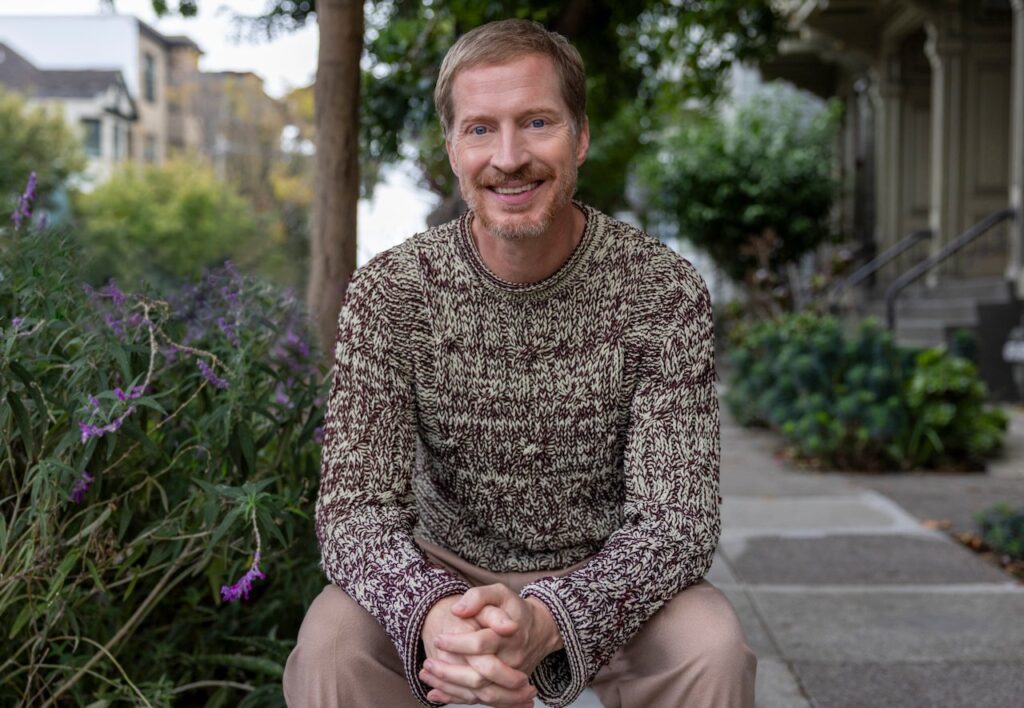
Building believable characters involves allowing them the freedom to form while writing, without letting them get out of control. Greer says experience means his characters never take over plot lines, but sometimes, they do re-appear more than he initially expected.
“The princess, who I thought would be funny to have, arrives at the beginning. She can’t understand (Geoffrey’s) American accent, which shocks our protagonist who thinks he speak with the purest English. It pops his provincialism. At the end, the princess returns and reveals that underneath her cartoonish character, there are depths of immorality and humor to teach him. It was the solution to ending my book.”
Another surprise was a cousin of the Baroness, a handsome aristocrat who becomes Geoffrey’s lover. Instead of the traditional, “handsome gardener becomes aristocrat’s lover” cliche, Greer reverse-engineered the story. “The protagonist is working as the gardener when the lover, a nervous man, arrives in an Ascot. It was wonderful to discover what he offers the protagonist and the protagonist’s response. Using him and without giving anything away, I can say I really understood (Geoffrey) and how he had changed.”
About writing comedic stories, Greer says it is tough. “To process the hardships—love, death, and war—into something you can walk through requires emotional, deep digging. A comedy does that gently. I find I can only write on that tough stuff for one sentence or two. Then I have to cover everything with a gloss so when the tough stuff comes, it means something to you.”
Imagination is the world he lives in, Greer claims, laughing. The Baroness tells of searching for pink porpoises on the Amazon River, one example of fanciful storytelling that still retains a foothold on reality. Bizarre solutions and ideas issue themselves quietly or with deliberate buoyancy. Geer suggests this provides multiple paths to escape the overwhelming imposition of today’s app-driven, AI-powered, non-human interactions.
Greer’s novel might make a fabulous movie and indeed, a few Hollywood producers showed up at his recent New York appearance. He feels stories told in books are best to remain in that genre because it allows for the depth of rich descriptions, long moments of memory, large movement in time or in characters’ point of view. Even so, he thinks Villa Coco has high cinematic potential, if the right actor to play the 92-year-old Baronessa can be found. (Can we suggest Julie Newmar or Mamie Van Doren?)
Meanwhile, Greer is already working on his next novel. “I learned long ago you have to be on another project before a book comes out. You could get your heart broken and not be able to move on because you’re stuck in the last book. Or, it could be successful and you’d be completely distracted by attention and Instagramming about it. The tour and attention are fun, but the point is to keep working.”
The post Andrew Sean Greer: ‘Everything’s terrifying to me—even buying a stick of gum’ appeared first on 48 hills.