AG Rayfield asks court to dismiss feds’ undercover license plate lawsuit against Oregon
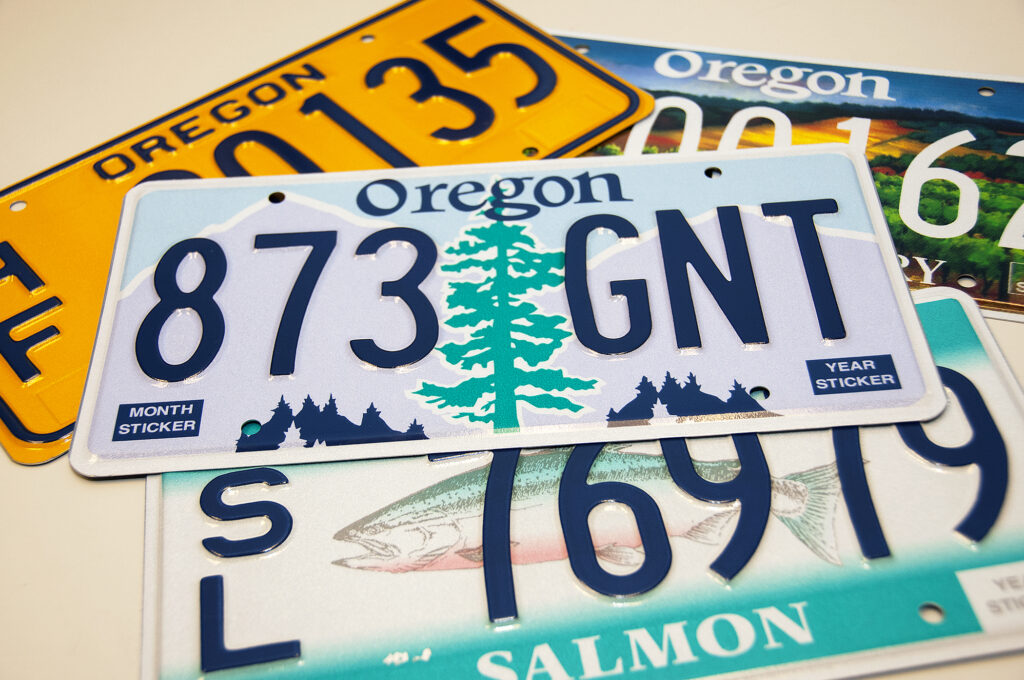
Oregon license plates are at the center of a legal battle over the state’s sanctuary protections and federal immigration enforcement efforts. (Photo courtesy of the Oregon Department of Transportation/Flickr)
State attorneys have asked a federal judge to dismiss a lawsuit that seeks to force Oregon to offer undercover license plates to federal agents, arguing that the Trump administration cannot force the state to use its resources to enforce federal law.
The development came in a Tuesday legal filing responding to the federal government’s May lawsuit over the Oregon Driver and Motor Vehicle Services Division temporarily blocking access to the plates for all federal law enforcement agencies. Gov. Tina Kotek has since said she will block U.S. Immigration and Customs Enforcement and U.S. Customs and Border Protection from access to the plates.
Legal observers, meanwhile, say the federal case could test how far state sanctuary laws can go in allowing states to negotiate the terms of their cooperation with federal immigration enforcement. Oregon’s decades-old sanctuary law prevents state and local governments from using resources to assist federal immigration enforcement without a judicial warrant.
Attorney General Dan Rayfield, alongside two other state attorneys, argued that the Trump administration lacks standing and cited the anti-commandeering doctrine grounded in the U.S. Constitution’s Tenth Amendment. Since the 1990s, the U.S. Supreme Court has generally interpreted the doctrine to prevent federal officials from co-opting state and local governments for their own purposes.
“Defendants admit that the public interest favors maintaining our system of federalism and the constitutional lines drawn between federal and state power, but defendants deny that this balance has been upset by defendants’ conduct,” the Oregon attorneys wrote. “Defendants admit that the public has an interest in the safe and effective enforcement of the law, but defendants deny that their conduct has adversely affected such enforcement.”
The original lawsuit alleged Oregon is discriminating against the federal government by refusing to issue undercover federal agents standard state license plates, opening up officers to being followed and targeted during sensitive operations for immigration enforcement and criminal investigations.
State officials maintain that individual license plate registrations are not tied to the identities of federal officers, and that federal agents currently using active registrations for undercover plates may continue to do so. They also say that vehicles using license plates associated with the federal government are free to operate on Oregon roads.
Oregon began its pause last year
While the lawsuit offers some of the clearest insight into how Oregon plans to defend its actions in court, state officials have offered less detail as to what prompted Oregon’s DMV in April to quietly decide to join other Democratic-led states in blocking access to the plates for federal agents. The state’s undercover license plate program offers the plates to 45 federal agencies and about 1,260 different plates are currently in use in the state, according to the governor’s office.
The governor’s office told the Capital Chronicle on Wednesday that Oregon stopped issuing undercover license plates to ICE in late 2025. State officials were deliberating over whether they had the legal authority to single out federal agencies primarily working on immigration enforcement or if they should halt access to the license plates for all federal law enforcement.
The agency already had authority under Oregon law to withhold the plates, according to Kotek’s office. State law allows Oregon’s transportation department to issue plates or other evidence of registration for undercover vehicles used by federal, state, local and tribal law enforcement undertaking criminal investigations. The statute does not mention immigration enforcement, which falls under civil law.
Kotek announced in June that she would block ICE agents and U.S. Customs and Border Protection agents from receiving undercover plates. She has declined to extend the restrictions to other federal law enforcement agencies assisting immigration enforcement under the Trump administration, arguing that they have real public safety needs.
“Federal law enforcement agencies, including the U.S. Marshals, have legitimate needs that do not conflict with state sanctuary law,” a spokesperson for the governor’s office previously told the Capital Chronicle. “The governor does not want to impede efforts that ensure public safety and that is why she asked that DMV restrict access to undercover license plates only to those agencies that primarily conduct immigration enforcement.”