After Boyle Heights warehouse fire, residents take environmental testing into their own hands
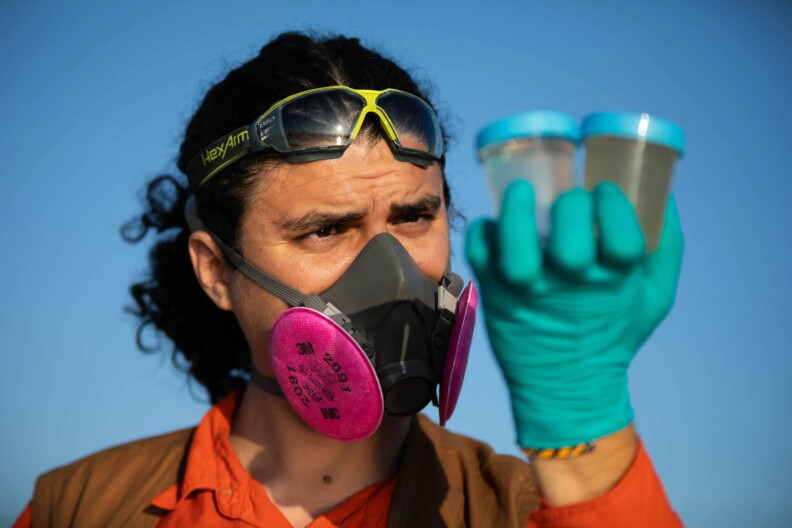
Wearing gloves and a KN95 mask, Emmanuel Carrera Ruedas hunkered down near a storm drain, just steps away from the smoldering Lineage warehouse fire, as he filmed himself pointing to what he described as insulation and foam flowing into the drain.
“The thing about this water is that it all gets dumped straight into the L.A. River,” Carrera Ruedas, of Cudahy, told his Instagram followers in a June 22 reel.
In the past two weeks, Carrera Ruedas has spent evenings gathering water samples outside Lineage and from the L.A. River as he and other community scientists are partnering with experts from UCLA and Columbia University to learn what’s in the runoff. Samples will soon be sent to a lab in New York.
“For far too long, the river has just been a drainage, a dumping site for companies,” said Carrera Ruedas, 27, who often encounters toads, birds and fish inhabiting its ecosystem.
“There is life in there,” he told Boyle Heights Beat. “We’re all in proximity to the river, and that’s kind of the vein that runs through the city that really connects us all.”
Community-led testing
Since the Lineage fire ignited June 17 in Boyle Heights, residents, environmental advocates and researchers have taken it upon themselves to find out what’s in the air and water. They’ve launched their own sampling efforts, seeking answers about what people have been breathing and contaminants that may have entered the L.A. River.
The community-led testing comes as residents have reported eye irritation, nausea and headaches while questioning whether the government has done enough to capture the fire’s environmental and public health impacts.
Those concerns are especially alarming in Boyle Heights, East L.A. and neighboring Southeast L.A. communities, where neighbors have long faced disproportionate pollution burdens.
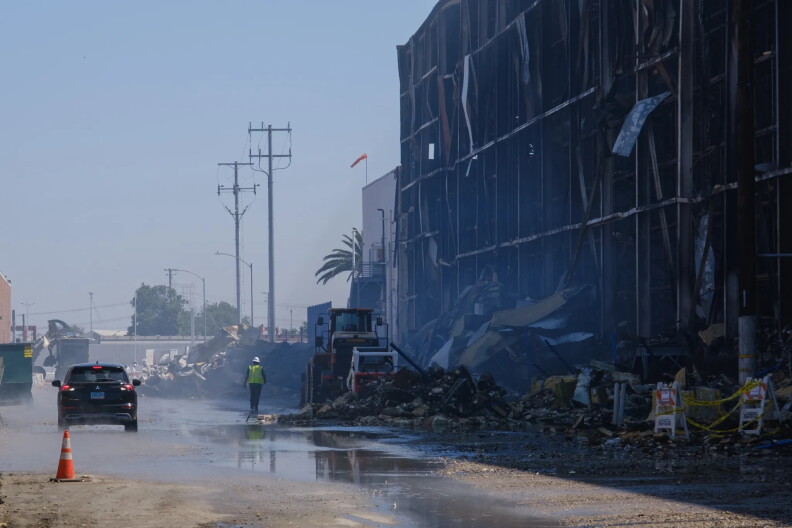
An estimated 31,700 workers, about 81% of whom are Latino, live in the county and city zones where a smoke advisory was issued, according to new data from the UCLA Latino Policy & Politics Institute. They work in health care, manufacturing and food service industries. About half of the workers earn $3,333 or less a month, below L.A. County’s “very low income” threshold.
The area also experiences diesel pollution levels three times the county average, as well as higher rates of asthma and cardiovascular disease-related emergency department visits, according to UCLA. Nearly 10,000 households in the area lack air conditioning.
“This is not only an air quality emergency but also a worker and environmental justice issue,” UCLA said.
Behind the push for environmental justice
For years, East Yard Communities for Environmental Justice has shed light on how Latinos on the Eastside often bear the brunt of the region’s pollution and climate disasters, such as the East L.A. oil spill in late May that dumped nearly 25,000 gallons of crude oil onto streets and into the L.A. River. For the organization, “We are just trying to breathe” is a common phrase.
“Something I’ve told many people over a long period of time is, ‘We’re not polar bears. We’re not whales.’ Nobody is coming to save us. We have to step up and defend ourselves,” said mark! Lopez with East Yard Communities for Environmental Justice.
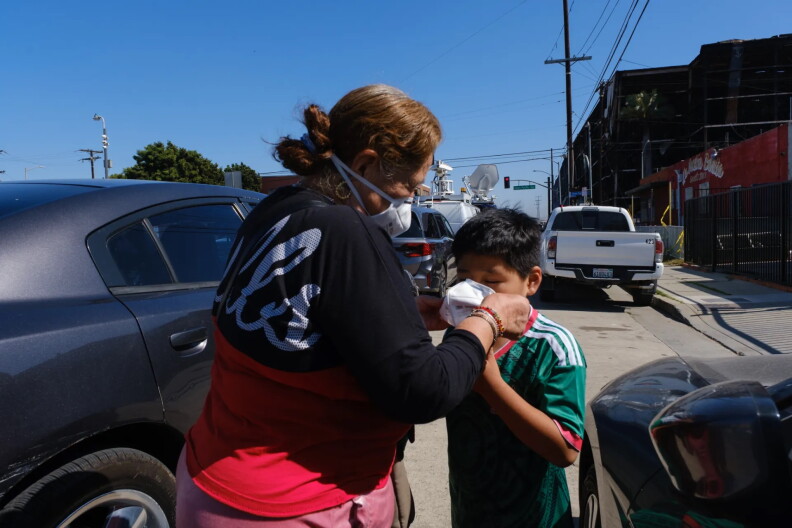
East Yard members opted to take air samples themselves, dissatisfied with the South Coast Air Quality Management District’s assessment of the fire’s air-quality impacts. They placed sorbent tubes, which Lopez described as passive air monitors, outside nearby homes for about seven days. Soon, they’ll send the findings to a Columbia University lab with the help of UC Irvine.
What officials have done so far
South Coast AQMD said it conducted “mobile monitoring” during the first two days of the fire that found “significantly elevated concentrations” of particulate matter. The agency then deployed particulate matter monitors at Eastman Avenue Elementary and Robert Louis Stevenson Middle School that provide “near-real time exposure information.” AQMD noted that the L.A. Fire Department and the U.S. Environmental Protection Agency conducted their own monitoring, while third-party contractor Onterris has continued monitoring during the cleanup phase.
AQMD also observed smoke impacts throughout the region, issuing a particle pollution advisory in English and Spanish that remained in effect through June 24.
What’s next and lingering questions
Meanwhile, Lopez said more sampling is necessary, and he questioned the effectiveness of efforts by Lineage, AQMD and LAFD. He and other advocates criticized public statements from officials, including Mayor Karen Bass’ assurances that “the air is not dangerous,” even as residents were reporting feeling sick. He also took aim at LAFD Chief Jaime Moore’s statements that ammonia was not toxic to individuals unless they had respiratory issues or came in direct contact with it. East Yard also called for evacuations in the area.
“It feels like at the city and county level they don’t currently have the capacity to really handle this situation,” Lopez added. “I think it really requires state and federal intervention to make sure that the cleanup and restoration isn’t mismanaged.”
Yoshira “Yoshi” Ornelas Van Horne, an exposure scientist and assistant professor with the UCLA Fielding School’s Department of Environmental Health Sciences, said the Lineage fire is exposing how little is done to “respond to public health emergencies and disasters” in communities like Boyle Heights and East L.A., areas “that have so often been referred to as environmental injustice communities.”
Residents and community organizations like East Yard, Ornelas Van Horne said, “are always the ones having to respond.”
“They’re relying on each other. They’re relying on their networks and their organizing power to be able to do that on the ground sampling.”
Ornelas Van Horne reached out to colleagues at Columbia’s Multi-Element Trace Analysis Laboratory in New York after she learned of the sampling taking place and of community concerns about the runoff making its way down to the L.A. River.
Those samples will be analyzed for heavy metals like cadmium, lead and arsenic, she said.
The L.A. County Public Works Department, according to the Los Angeles Times, deployed three containment booms on the L.A. River and continued to monitor the water as it made its way to the ocean.
Carrera Ruedas began collecting water samples on the third day of the fire. He said he took the first sample from the L.A. River, about 100 meters from the spout where it spilled out. The second was taken from outside Lineage. He has amassed dozens of samples since then.
Cudahy sits alongside the lower L.A. River, and after the fire, Carrera Ruedas recalled a “heavy stench that affected people in our community.” The trash he saw in the river was the foam and insulation that came from Lineage, he said.
“It really pissed me off, just to see all this trash go in there and nobody doing anything about it,” said Carrera Ruedas, who also serves as the parks and environmental justice commissioner for Cudahy.
The L.A. River, Carrera Ruedas said, is “part of our ecosystem.”
“This is not just affecting me. This affects everybody else around me. This affects people who love the beach, people who just want our water systems clean,” he said.