Mayes declines to prosecute Hobbs for Sunshine Residential bribery accusations
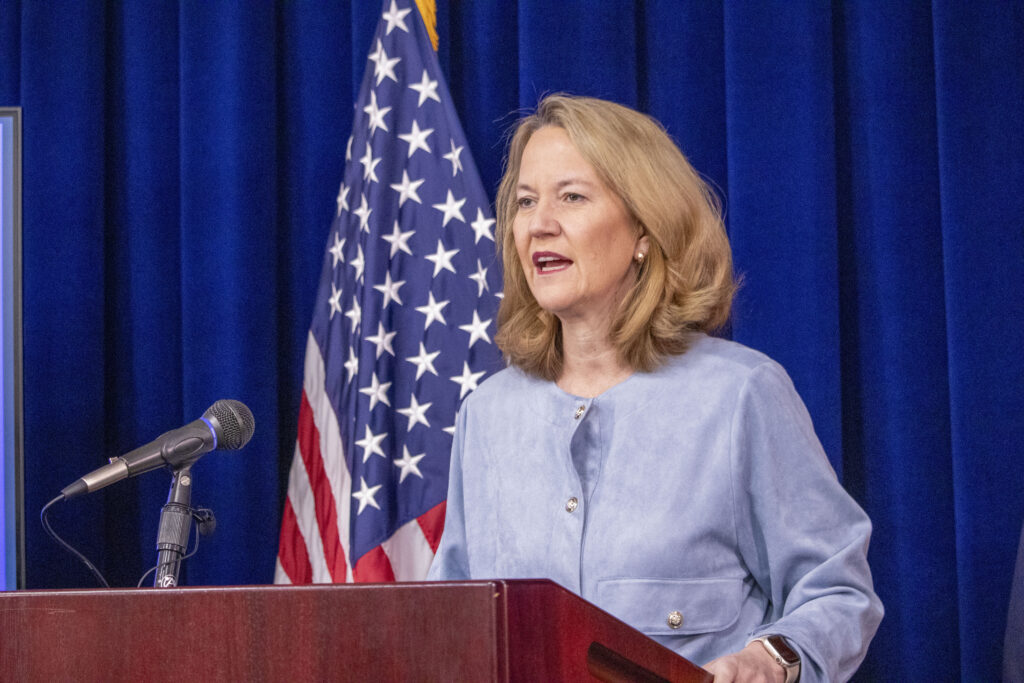
Attorney General Kris Mayes speaks to reporters on June 1, 2026. (Photo by Jerod MacDonald-Evoy/Arizona Mirror)
Attorney General Kris Mayes says there’s no evidence that Gov. Katie Hobbs broke the law when her administration awarded a pay increase to a foster care provider that donated more than $400,000 to her political campaign.
Two years ago, an Arizona Republic investigation found that Sunshine Residential Homes received a nearly 60% increase in the rate it charges to house foster children. The company made hundreds of thousands in campaign contributions to Hobbs’ 2022 gubernatorial run and its CEO, Simon Kottoor, was on the Democrat’s inaugural committee. The report prompted Republican lawmakers to petition Mayes to conduct an investigation for potential bribery and has been a political thorn for Hobbs since.
But on Friday, Mayes released a report absolving Hobbs of any blame. Mayes concluded that there isn’t enough evidence to link the donations to the hike in rate increases and said she would decline to prosecute Hobbs. Doing so, she said, would only open up the state to an anti-SLAPP case, because campaign contributions are protected by the First Amendment and Republicans have frequently used the allegations against Hobbs as a political talking point.
“After two years of investigation, consisting of multiple interviews, reviews of campaign-finance records, procurement records, bank documents, and State emails and chats, totaling over one terabyte of data, including more than 100,000 documents, the investigation has not uncovered any evidence of the necessary quid pro quo to support a bribery charge,” Mayes said, in a written statement.
Instead, Mayes called on the Arizona Legislature to pass laws to make political donations from state contractors more transparent. Mayes’ investigation also revealed another $150,000 that Sunshine Residential donated to a legal defense fund set up by Hobbs to pay for election challenges from her Republican opponent Kari Lake.
In a statement posted to the social media site X, Christian Slater, a spokesman for Hobbs, said the report confirms that Hobbs has always had the state’s best interests in mind.
“The report released today clearly states that there was no wrongdoing by the Governor or her office,” Slater wrote. “As has been publicly reported multiple times and the Attorney General’s report now confirms: Governor Hobbs was not involved in, did not direct, and did not instruct any member of her administration regarding the rate increases the Department of Child Services approved. Governor Hobbs always puts Arizona first and that’s why she’s focused on lowering costs, securing the border, and delivering results for Arizona’s families.”
Republicans, meanwhile, accused Mayes of protecting her political ally. State Sen. Warren Petersen, a Republican who is hoping to unseat Mayes in November, said her failure to charge Hobbs is proof that voters should award him the attorney general’s seat.
“After dragging her feet on the pay-to-play allegations against her Democratic pal, Kris Mayes announced her refusal to hold Governor Katie Hobbs accountable for her actions,” Petersen said, in a written statement. “Once again, Mayes has proven herself unfit to lead the Arizona Attorney General’s Office, putting politics ahead of enforcing the law.”
Republican congressman Andy Biggs, who is challenging Hobbs for the chance to lead the state for the next four years, lambasted the report as a coverup. Biggs highlighted Hobbs’ refusal to sit down with investigators as proof that she is guilty and called on voters to respond by ousting her and Mayes in the fall.
“With today’s report whitewashing obvious corruption, Arizonans can see why Democrat Katie Hobbs thinks she’s above the law,” he wrote. “The best way for Arizonans to now push back against this embarrassment is clear: voting Katie Hobbs and Kris Mayes out of office in November.”
The report emphasized that while Sunshine Residential held the most lucrative state contract among over a hundred providers during Hobbs’ tenure, the rate at which its contract increased was outpaced by two other providers. The Arizona Department of Child Safety pays providers rates based on the number of beds available for children on a daily basis. Sunshine Residential, which is the largest provider DCS works with, has consistently commanded high pay rates, even before Hobbs took office. In 2019, the group home provider’s pay rate was exceeded by only two other providers. By 2024, a little over a year into Hobbs’ tenure, Sunshine Residential’s pay rate jumped by 56% to the highest pay rate in Arizona at $234 per bed. Two other providers saw greater pay increases of up to 85%, but still had lower per-bed pay rates.
The bribery allegations stem from two pay rate increases made under Hobbs, one of which was awarded mid-contract and another that occurred during a contract renewal. During interviews with David Lujan, who was then the head of DCS, the mid-contract increase was justified as necessary to keep Sunshine Residential as a provider amid threats that it would instead turn to a better paying federal offer. Lujan told investigators that two providers had already shifted to federal contracts and that Sunshine Residential was particularly valuable because it was one of the few providers willing to take on siblings. Lujan said he never once received an indication from the governor’s office that he should increase the group home’s pay rates, and added that he only notified Hobbs’ office of the increase after it was approved.
But at least one DCS employee felt pressured by the donations to Hobbs’ gubernatorial campaign. Then assistant director Robert Navarro, one of two employees who advised Lujan to approve the mid-contract pay increase, told investigators that the campaign contributions “put pressure on, I think, everybody.” Navarro mentioned the donations during a meeting with Lujan before a new contract with Sunshine Residential was completed and also spoke about them in an employee chat with another employee, who characterized those discussions as nothing more than banter between friends. Ultimately, investigators concluded that the pressure Navarro talked about was self-imposed.
Lujan and employees denied ever receiving directions from Hobbs’ office to increase the pay rates for Sunshine Residential. And Hobbs herself, who declined to be interviewed, said through attorneys that she never discussed pay rates with Kottoor and was unaware of the pay increase while it was happening. Investigators posited that the pay rate hike had more to do with Sunshine Residential’s outsized leverage as the largest provider for DCS than any pay-to-play scheme.
In the end, Mayes wrote, there simply isn’t any evidence to suggest that Hobbs agreed to a bribe in exchange for a more lucrative contract.
“Certainly, the timing of Sunshine’s large political contributions, followed by Sunshine’s rate increases, including receiving the highest per-day rate, raised serious questions that
prompted this investigation,” Mayes wrote. “But in the absence of any evidence to suggest a quid pro quo, it is insufficient to establish a crime occurred.”
Mayes noted that charging Hobbs with bribery would only lead to the case being thrown out of court. That’s because Arizona’s bribery laws require clear evidence that a payment was made in exchange for an explicit promise and the courts, including the U.S. Supreme Court, have ruled that it isn’t enough to theorize that there’s a link between a donation and an action later taken by a state official.
Mayes added that prosecuting the case would likely prove difficult because there’s plenty of evidence for Hobbs and Sunshine Residential to counter with an anti-SLAPP defense. Arizona law empowers people to defend themselves against lawsuits intended to “deter, retaliate against or prevent” a person from exercising their constitutional rights, including the right to make political donations as a form of free speech. Mayes pointed out that Republican lawmakers, along with petitioning her office to open an investigation, also prompted investigations at the Maricopa County Attorney’s Office and with a St. Louis-based law firm with ties to President Donald Trump. On top of that, Republican critics of Hobbs have repeatedly referred to the bribery investigation in political ads in an effort to turn voters against her.
This isn’t the first time the state attorney general has been asked to look into allegations of political bribery and declined to pursue a lawsuit, Mayes pointed out. In 2020, another Arizona Republic report exposed a trend from then Republican Gov. Doug Ducey, whose administration awarded public contracts to companies friendly with Ducey and later donated to his political campaign. The attorney general’s office, at the time under Republican Mark Brnovich’s leadership, ultimately concluded that the contracts were perfectly legal and there was no wrongdoing at play. In her report on Hobbs’ alleged bribery, Mayes said that it would be difficult to explain to a court how the case against Sunshine Residential was different from the ones that were never pursued against Ducey.