Timberwolves Julius Randle trade gives team room to build around young core
During his four-year tenure as president of basketball operations for the Minnesota Timberwolves, Tim Connelly has been pretty adept at rectifying gambits that haven’t paid off. Unfortunately, that’s taken up quite a bit of his time recently.
Quickly getting off mid-tier bench players like Bryn Forbes, Shake Milton and Troy Brown, Jr. is one thing. Moving on from a lottery pick less than two years after you used one of your few precious resources to address your most obvious position of need, as happened with Rob Dillingham in February, is an erasure that’s tougher to clean.
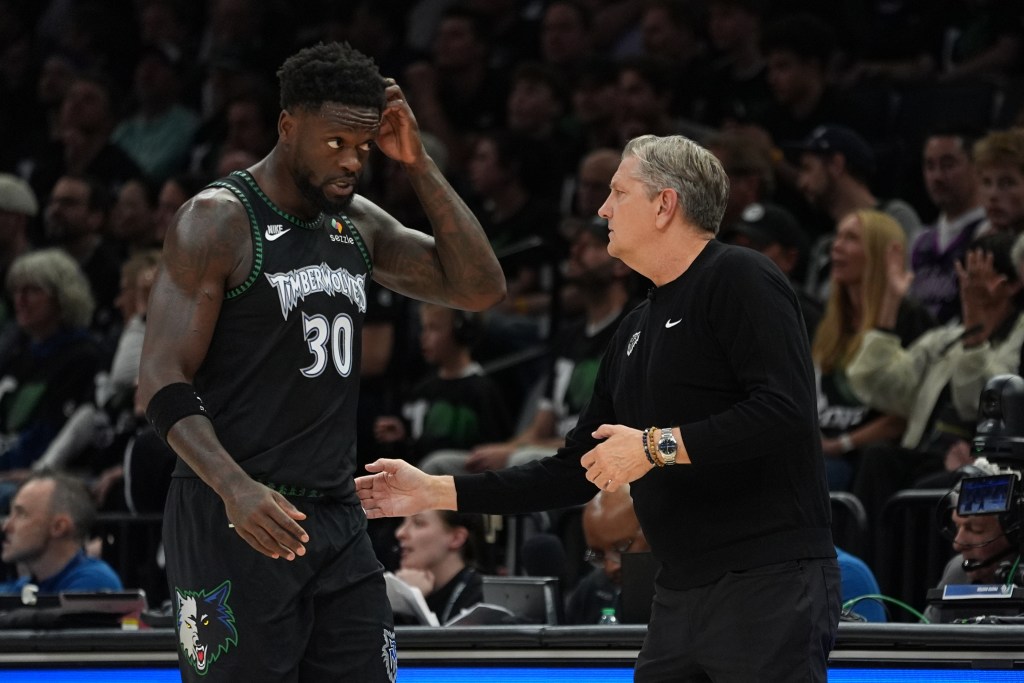
Now comes the salary-dumping of Julius Randle, executed the morning of the NBA draft this Tuesday. Head coach Chris Finch deemed Randle “maybe our most important player” in the midst of him leading the Wolves in assists and finishing second to Anthony Edwards in scoring during the first season of his three-year contract.
Related: Seems apologies are due to the Timberwolves leadership and Julius Randle
But too suddenly, that deal became an albatross. Randle is headed to the Brooklyn Nets because they are one of the very few franchises with enough salary-cap space to absorb his $33 million salary next season (Randle also has a $36 million player option for the 2027-28 season). Taking on Randle required the slight sweetener of the Wolves 28th pick in exchange for Brooklyn’s 33rd pick in Tuesday night’s draft. To satisfy the complicated terms of a third team, the Chicago Bulls, also being involved in the deal, the Wolves will receive nondescript power forward Mo Gueye, who has played just 165 NBA minutes and is almost certain to be waived before ever suiting up for the Wolves.
Connelly’s critics were already animated by watching Karl-Anthony Towns play a key role in the New York Knicks’ championship run in the second year after KAT was swapped for Randle, Donte DiVincenzo, and a draft pick that became center Joan Beringer. That a ring is on his finger so soon after he was part of a Wolves rise to the Western Conference Finals in 2024, overwhelms reasonable arguments about needing to get off KAT’s contract (he was paid $53 million this season) in order to sustain a young core that includes Ant, Jaden McDaniels and Naz Reid.
Some would take it a step further back and deride Connelly’s acquisition of Rudy Gobert, which punted a ton of draft capital and made KAT’s contract, and natural position at center, less tenable. But in my view, the largest pratfall involving Randle was not acquiring him for KAT, but resigning him last offseason, at the expense of letting Nickeil Alexander-Walker go to Atlanta, where NAW promptly performed at a level that officially earned him the NBA’s Most Improved Player award, fulfilling many of the same scoring and playmaking duties that fell to Randle for almost exactly half-as-much money.
Connelly, and Finch too, are culpable for these roster decisions. Ironically, the two players where you could see rare cracks in the united front put up by the POBO and head coach are Dillingham — clearly favored by Connelly more than Finch — and Randle, a notorious Finch favorite. To be clear, there wasn’t blatant friction, just a pair of situations where one was extremely enthusiastic and the other much more neutral.
If you get past the cynicism and go to the rectifying, there are genuine silver linings in the departure of both Dillingham and Randle. Losing the former enabled the Wolves to acquire Ayo Dosunmu, who conclusively demonstrated what a boon playing at an accelerated pace could be for the Wolves. It’s not a coincidence that the Randle salary dump came nearly in sync with news that the Wolves are signing Ayo to a 5-year, $112 million package, a contract that would have hamstrung any other roster development if Randle was still on the team.
But that’s not the only way losing Randle represents addition by subtraction. His inaccuracy from three-point range was a burden on a lineup alongside Gobert, and his usage and lack of spacing created obstacles for Ant. His tendency to coast on defense was damning. And the decline in his performance in the second round of the playoffs against the Spurs, capped by his leaving Target Center without ever addressing the media, portended the likelihood of his exit from the team.
Repeating wisdom delivered by my podcast partner Dane Moore (whose command of the salary cap and team management in general allowed him to sketch out the parameters of this very kind of salary dump weeks ago), trading Randle enabled the Wolves to get under the first apron of the cap and thus able to offer free agents the “non-taxpayer midlevel exception,” which he describes as a “$15 million gift card for teams to spend above the salary cap but below the first apron.” And because the Wolves didn’t take back any costly assets in the Randle deal, they now have a $33.3 million trade exception — crucial and sizable wiggle room for transactions, not only this summer, but for a full year after the salary dump.
Related: With flashy confidence, Minnesota Lynx’s Olivia Miles makes seamless entry to WNBA
Put simply, losing Randle gets you Dosunmu for five years at a salary that should make him happy, while providing you the chance to make further upgrades on the roster. It tosses away an ill-fitting piece in both playing style and timeline, in exchange for elevating that younger core of Ant’s peers, Naz and McDaniels. Naz has always thrived on defense next to Gobert and after years of waiting behind KAT and then Randle, should finally enter the starting lineup. Meanwhile, McDaniels will be given more space and freedom to operate as playmaker and second-level scorer.
Meanwhile, instead of focusing on KAT as the bauble of the Knicks championship, consider that the three best teams in the NBA all relied heavily on wing depth from young, two-way players who get after it on defense and play selflessly on offense. The Wolves had a character issue during their 2025-26 season and while Randle can’t be scapegoated for all of it, he contributed to it. Going into 2026-27, the Wolves now have Ant, McDaniels, Naz, Ayo, Beringer and TJ Shannon locked up for at least the next three years, with a greater ability to add pieces without onerous penalties from overspending.
Drafting Dillingham and resigning Randle were costly mistakes. And while the Wolves still owe the already mighty Spurs a 2031 first round pick from the Dillingham deal, they have the youth, the continuity, and the right elements for a championship template in place to meaningfully move forward.
The post Timberwolves Julius Randle trade gives team room to build around young core appeared first on MinnPost.