A Queer Texan Retraces Steinbeck’s 10,000-mile trip
John Steinbeck was already suffering serious heart trouble when, in 1962, he and his dog clambered into a pickup with a camper topper for a cross-country trip chronicled in his famous final book, Travels with Charley.
Six decades later, Austin writer Lauren Hough sets out in a 2001 Dodge Ram van with her dog, a mutt named Woody, to discover whether they can survive a similar 10,000-mile trip in a much-altered America. The title of her resulting book comes from Steinbeck, who dubbed America: “a monster of a land.”
Tension crackles as Hough and Woody head almost immediately for the Deep South, a region where Hough had previously run afoul of a redneck sheriff during her stint in the U.S. Air Force.
Hough is no wimp. Her past professions include, according to her bio, “an Air Force airman, a bartender, a bouncer, a construction laborer, a driver, a green-aproned barista, and a cable guy.”
Her prior book, an essay collection called Leaving Isn’t the Hardest Thing, describes how she endured growing up in a cult, a stint in the military as an LGBTQ+ airman in a don’t-ask-don’t tell environment, incarceration in a solitary prison cell, and sexual assault.
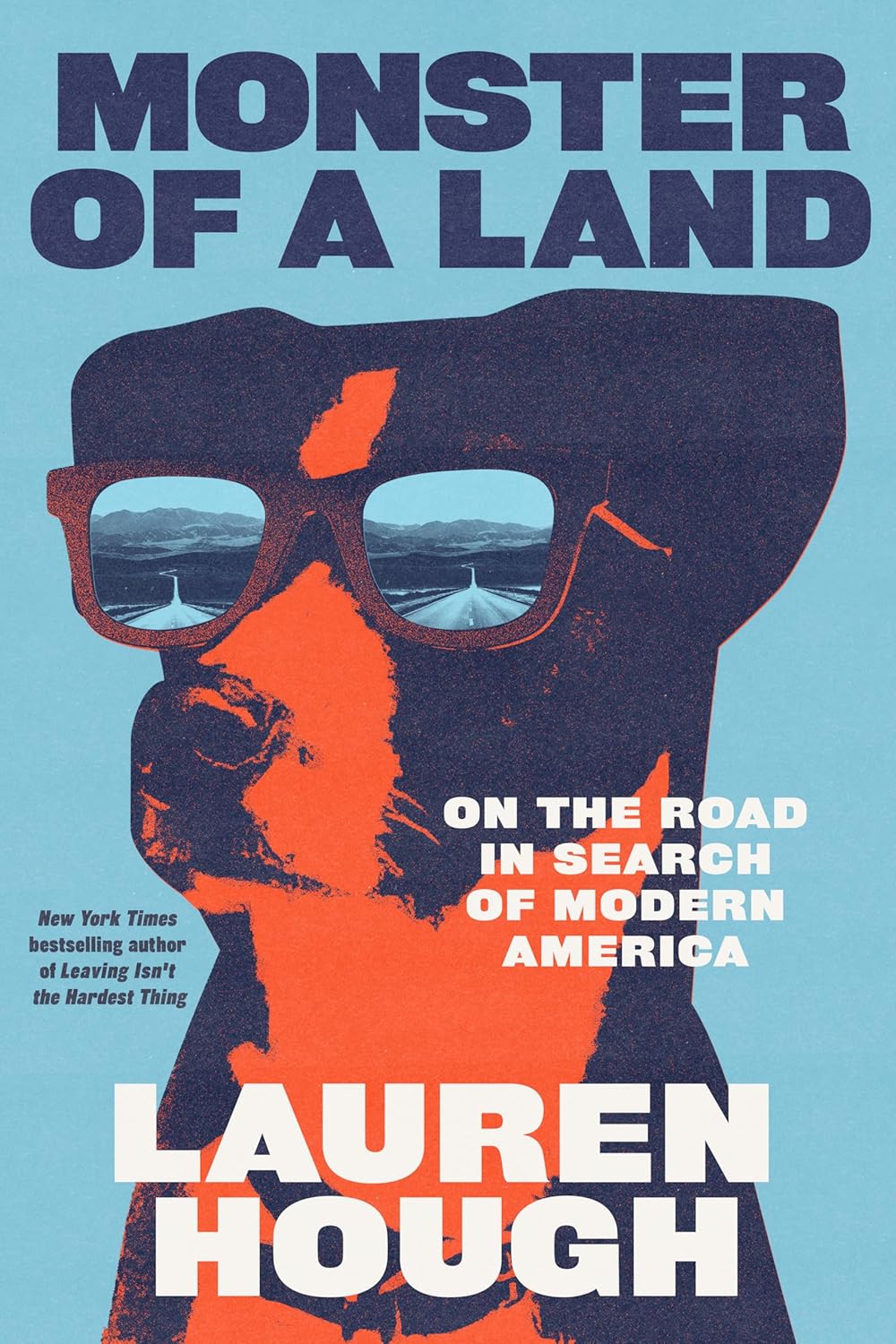
Yet in her opening chapters, Hough is nervous enough about this particular road trip that she’s enormously grateful to the handy friend who built a solid base for her on-board toilet. In fact, she seems overly effusive about the elaborate private privy. Only later do readers learn that Hough views that throne as critical security, given attacks she’s faced as a tall Queer person with close-cropped hair in attempts to use public women’s bathrooms.
For their journey, Hough and Woody, a husky pit rescue named after the iconic singer-songwriter Woody Guthrie, must rely on their not-so-trusty transportation, which Hough describes as a “2001 Dodge Ram van that looked like it might belong to a retiree over the meth cook and over the next few months would confound every mechanic who agreed to look at it.” Hough attempted to improve their survival odds by affixing a few corny fishing stickers to the bumper.
She also preps by reading Travels with Charley for the first time. She learns that other authors and critics have skewered Steinbeck’s nonfiction as heavily fictionalized. Notably, he hides that his wife joined him for more than half the trip and that he rarely slept overnight in his trusty travel trailer. Instead, he favored fancy hotels, resorts, and the estates of wealthy friends. (My Luxury Sojourns with Elaine and Charley) would have been a very different book.)
Hough’s stops tend to be spartan, if not dodgy. She seeks out dog-friendly beaches and remote forest roads and, at times, follows directions down unmarked dirt roads from wanderers, including people who consider themselves modern hobos or missionaries, rather than homeless or, in more liberal parlance which Hough sometimes mocks, “the unhoused.”
In 2010, journalist and author Bill Steigerwald delivered a blistering indictment after retracing Steinbeck’s 11-week journey that hit 40 states in a book dubbed Dogging Steinbeck. After cross-comparing maps, letters, and biographical materials and retracing the author’s route, Stigerwald concluded that most of the characters Stainbeck encountered were likely fabricated and his settings altered. In a related 2011 essay, “Sorry Charley,” he labeled Steinbeck’s work “something of a fraud.”
Yet Seigerwald’s strong critiques seem to ignore the differences between the 2010s and the era of Steinbeck’s trip, On the road, Steinbeck, the author of classics like Of Mice and Men, Grapes of Wrath, and Cannery Row, certainly would have attracted attention from eccentric characters who were either down-on-their-luck or over-the-top. And many more proudly weird and eccentric people, from hippies to cult members to draft dodgers, were hitchhiking in 1960s America.
In the 2020s, Hough offers Steinbeck appreciation for not ending his book by killing off poor Charley ( and thus increasing the trauma she experienced as a dog-loving child by reading Old Yeller or Where the Red Fern Grows).
“Thank fuck the dog survives,” she muses. Nor does it offend her that Steinbeck—who undertook a 10,000-mile road trip in his 50s and suffered heart trouble after a lifetime of smoking—might crave comforts after driving long hours with a dog. (Steinbeck died in 1968, six years after his travel book appeared.)
Hogue’s 2020s travelogue set in post-COVID-apocalypse America offers some of Steinbeck’s seemingly fanciful 1960s characters’ modern street cred—given the very colorful folks she meets in her own rambles. Unlike Steinbeck, who took few notes and likely relied on memory–or imagination–Hogue perpetually stops to record her journey, eventually filling a whopping 900 pages that, under editors’ orders, is boiled down to 310, some 50 pages longer than Travels with Charley.
Some of her most memorable musings come after Hough engages people who wander without her resources. One early encounter occurs in New Orleans, the city where Steinbeck called off his road trip and headed home.
Just outside the city’s famous Cafe du Monde, Hough spots an unnamed elderly New Orleanian wearing a tracksuit who is ignored and insulted as she begs from individuals waiting in a line for beignets. Hough joins this queue—along with Woody, since the restaurant offers a handy outside cash-only window—and overhears a trio of obnoxious snobs rebuff the woman, first claiming they have no cash and then scoffing: “She doesn’t even look homeless.”
Hough sees the woman retreat to lean against a brick wall and then waves her over.
“Her name was Dorothy,” Hough writes. “I could hear the pride in her voice when she told me she was born and raised just over in the Ninth Ward.” Dorothy, Hough learns, lost her home, like thousands of others, in Hurricane Katrina about two decades ago. And three years prior she’d suffered a stroke and lost her job.
Their conversation is interrupted when another tourist hollers out a warning and misgenders Hough: “Hey bro, it’s a scam.”
Instantly, Hough and her dog decide to hate him.
“I wished Woody was an attack dog. I wanted to ask him how the fuck breakfast is a scam,” she writes. Hogue offers Dorothy $20 for food, which her new acquaintance is forced to gum, given that while “living rough” she has been robbed of her last set of dentures.
A few miles later down a Gulf Coast highway, Hough crosses the Mississippi state line and reaches the Redneck Riviera, where she learns that the feds’ post-Katrina efforts did help rebuild another American’s home—the stately Mississippi plantation of slave-owner Jefferson Davis, the president of the rebel Confederate States of America.
“The good news is that, since it is designated a historic landmark, federal funds that might’ve been used to fix literally anything else were used to rebuild the traitor’s last residence. Glad we took care of that,” Hough writes.
Some of Hough’s anecdotes are sharp, some musings are laugh-aloud funny, a few are rants filled with a stream of expletives over setbacks or maddening on-the-road realizations as Hough explores an America that, in many ways, seems just as divided by political and economic differences as it was during Steinbeck’s trip.
Get the newsletter

Hough cannot time-travel to make her comparisons. She does attempt to avoid the cell phone’s siren call and steers clear of the interstates that arrived in the 1970s. While navigating backroads, she tries to ignore constant text alerts from friends and fans, as well as social media feeds that tend to magnify our divisions and our anger. That’s tough for Hough, a social media influencer whose posts on a Twitter account based on her prior dog often went viral. Yet In face-to-face encounters, she and Woody find far more tolerance and friendliness than expected.
Given the risks she takes and the attacks she’s faced, readers will be holding their breath for a major loss, scary breakdown, homophobic attack, or life-changing disaster for her or for Woody. Indeed, some disasters inevitably occur.
Spoiler alert: Hough survives her solo trip as an openly queer veteran, writer, and dog-lover to deliver a travelogue full of pathos, insights, solidarity—and some side-splitting and spot-on observations.
The post A Queer Texan Retraces Steinbeck’s 10,000-mile trip appeared first on The Texas Observer.