He’s been making 1-inch soccer players out of gum wrappers since age 10 — see them at LACMA
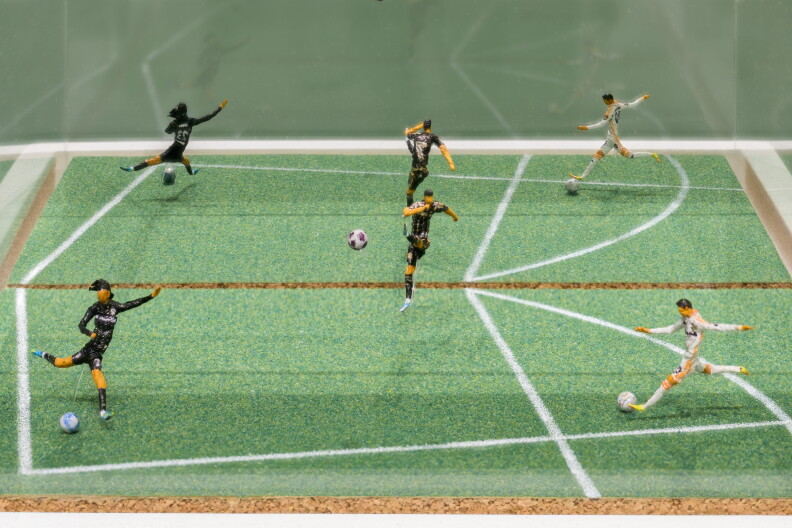
Countless soccer fans will stream into SoFi Stadium (temporarily renamed Los Angeles Stadium) in the coming days, or maybe catch a match at a neighborhood watch party.
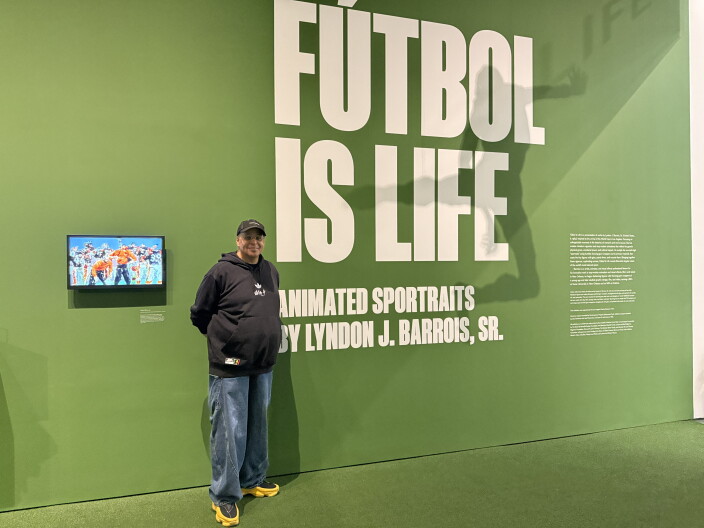
But right here in Los Angeles — at LACMA’s Resnick Pavilion to be specific — are a series of miniature face-offs too, thanks to a local artist who’s captured some big moments with the tiniest of soccer players in the exhibition, Fútbol Is Life.
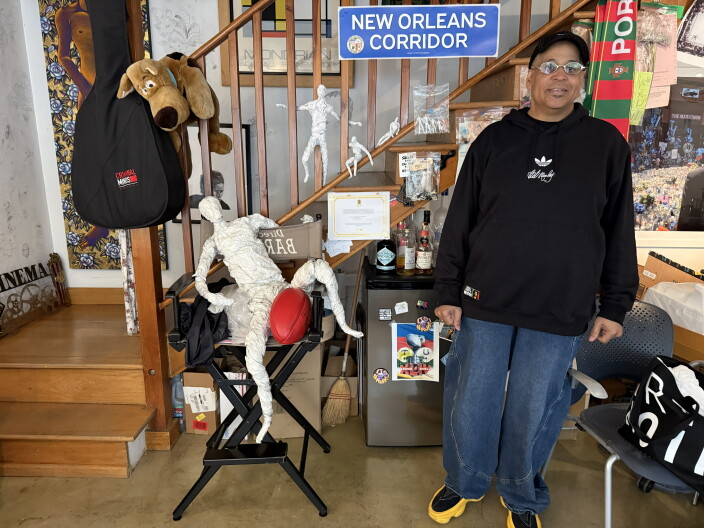
Artist and animator Lyndon J. Barrois Sr. gave me a tour of his home studio in Mid-City on a recent Friday. Tools of his trade are scattered throughout, including a glue gun, paint brushes and a life-sized recreation of a human skeleton.
And inside an orange, Halloween-themed Utz pretzel barrel, thousands of pieces of a material that sets Barrois apart: chewing gum wrappers.
“I find them around the world,” Barrois said. “When we travel, I see them on the ground and I pick them up. One trip we took to New Orleans… I must have come back with maybe two dozen. I found some in Lisbon, I found some in Marrakesh, I found some in Nairobi.”
Barrois crafts these little strips of foil and paper into art: one inch-tall, lifelike sculptures of humans in kinetic poses. Oftentimes, that means capturing his favorite moments from sports games with what he calls ‘sportraits.’
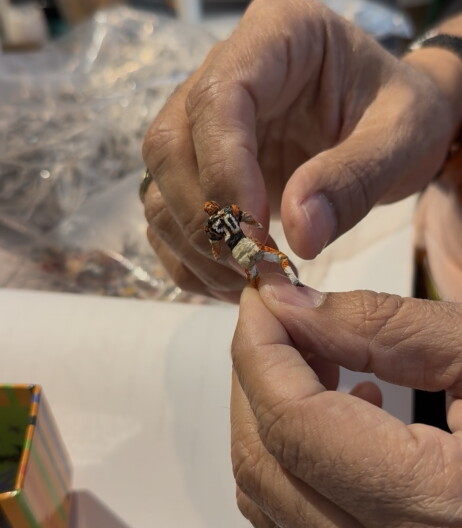
“All my life I was just making toys,” he said. “These are all my toys. Because I would play with these things like action figures.”
The small things in life
Barrois began making his miniatures at 10 in New Orleans, starting with the tiny drivers he made for his Hot Wheels cars.
Many of those original creations he’s held onto for five decades. Now they overflow from a Hershey’s Chocolate tin.
There are hundreds and hundreds of his tiny gum wrapper figures in Barrois’ studio: soccer players and boxers and football players with helmets so small he crafts them on pin heads.
It was while he was studying graphic design at Xavier University in New Orleans that Barrois says he realized his craft could be more than just a childhood hobby. One of his professors encouraged Barrois to take his miniature for what it really was: sculpture.
Barrois went on to get his master’s degree in film and video from CalArts in 1995 and has worked in animation and visual effects ever since, with credits on films like The Matrix Reloaded, Night at the Museum and Terence Malick’s The Tree of Life.
“It’s weird what things take you where,” Barrois said. “I always loved movies and wanted to do it in some capacity. I just didn’t know how. And to say that this is what led to all that, a childhood hobby, I don’t even know how to describe the feeling. Or how humbling it is,” he said.
Ravi S. Rajan, president of CalArts, said that whether Barrois is animating a monologue by author Ta-Nehisi Coates or creating special effects for a Matrix film, he makes his subjects more human and relatable.
“And I think that’s the magic of what he does as an artist,” Rajan said.
Barrois’ mastery in making his lilliputian figures has brought him into plenty of fine art spaces. Just a couple of miles from his home, Fútbol Is Life meticulously recreates historic moments from men’s and women’s soccer in a sizable space inside the Resnick Pavilion.
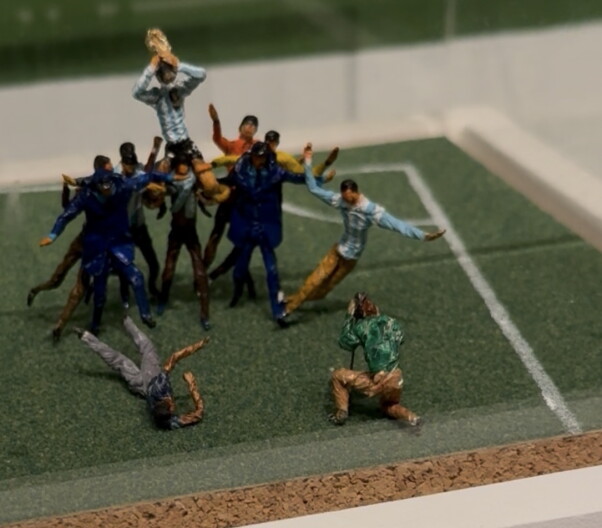
“You can imagine when they showed me this room, I was like: I gotta fill this room with little people!,” the artist said on a recent visit to his show.
And fill it he did. Inside clear cases there are dozens of scenes from soccer history spanning nearly a century of World Cup matches. That includes Brazilian footballer Marta Vieira da Silva celebrating a goal during a 2019 FIFA Women’s World Cup match.
“One of them that really gave me the most joy is probably the game where Marta kisses her foot after she scores. Because just the flex of that whole moment. I can’t kiss my foot, man,” Barrois said with a chuckle.
But there are less celebratory moments, too, like when German players gave a pre-kickoff Nazi salute before facing off against the Swiss team, foreshadowing a world that would soon be at war.
It’s a dark moment in history captured in a playful way that makes you look twice.
“That was the German team in 1938. Pre-World War II, but it was the rise of Nazism. And so that’s how the team saluted when they came out on the field,” Barrois said. “The importance of this was to also contrast what the same German team did in 2022. They wore ‘human rights’ on their T-shirts.”
Already writing history
As museum visitors look in wonderment at the minuscule scale of Barrois work, they are also drawn into some of these past realities.
“It makes the subject matter easier to digest. Because there’s a lot of tough subject matter here. But still, you pay attention to it,” Barrois explained.
Each vignette is a different conversation starter: from on-field protest moments, to celebrations of underdog victories to prisoners of war playing their beloved game on a dirt field.
Barrois said his exhibition is a deep dive into the history of the game. That includes “the players, the personalities, and the politics.”
“Because it’s countries. It’s bragging rights. It’s unification. It’s division. It’s all that,” he said.
And discourse arising from the current World Cup isn’t lost on Barrois. The Iran men’s team is scheduled to play two matches here in L.A., even as the U.S. war with their country looks like it will continue.
“This game is already writing history before it even begins with all this political stuff happening,” Barrois said.
“So it’s going to be interesting to see all the stories that get told out of this one.”
Maybe a job for some skilled hands… And a few humble gum wrappers.